Back to General Studies Print & PDF Edition

General Studies Compilation

MySarkariNaukri.com | Civil Services Prep

General Studies Complete Revision Notes

Compiled Prelims High-Yield Fact Matrices & Mains Analytical Doctrines

Total Articles: 12 Chapters
Updated: 4 November 2026
Aligned With: UPSC CSE, State PSC, SSC CGL
Complete Table of Contents
  1. List of amendments of the Constitution of India
  2. Indian Constitution: Schedules
  3. Borrowed Features Of Indian Constitution
  4. List of Recognised Languages
  5. Articles related to MPs, MLAs and MLCs
  6. Indian Polity
  7. Preamble of the Constitution
  8. UPPSC Syllabus
  9. HIGH COURT
  10. Lal Krishna Advani: Bharat Ratna Recipient in 2024
  11. The Paramara Dynasty: History, Administration, and Cultural Contributions
  12. COBOL Programming Language: Legacy Systems and Modern Relevance
Chapter 1

List of amendments of the Constitution of India

No.AmendmentsEnforced sinceObjectives1Amend articles 15, 19, 85, 87, 174, 176, 341, 342, 372 and 376.Insert articles 31A and 31B.Insert schedule 9.18 June ...
• Key concept: List of amendments of the Constitution of India • Essential for UPSC CSE Prelims, State PSCs, SSC CGL & Railway exams. • Comprehensive analytical coverage and factual pointers provided below.
No.AmendmentsEnforced sinceObjectives
1Amend articles 15, 19, 85, 87, 174, 176, 341, 342, 372 and 376.
Insert articles 31A and 31B.
Insert schedule 9.
18 June 1951Added special provision for the advancement of any socially and educationally backward classes or for the Scheduled Castes and the Scheduled Tribes. To fully secure the constitutional validity of zamindari abolition laws and to place reasonable restriction on freedom of speech. A new constitutional device, called Schedule 9 introduced to protect laws that are contrary to the Constitutionally guaranteed fundamental rights. These laws encroach upon property rights, freedom of speech and equality before law
2Amend article 81(1)(b).1 May 1953Removed the upper population limit for a parliamentary constituency by amending Article 81(1)(b).
3Amend schedule 7.22 February 1955Re-enacted entry 33 of the Concurrent List in the Seventh Schedule with relation to include trade and commerce in, and the production, supply and distribution of 4 classes of essential commodities, viz., foodstuffs, including edible oil seeds and oils; cattle fodder, including oil cakes and other concentrates; raw cotton whether ginned or unginned, and cotton seeds; and raw jute.
4Amend articles 31, 35 band 305.
Amend schedule 9.
27 April 1955Restrictions on property rights and inclusion of related bills in Schedule 9 of the constitution
5Amend article 3.24 December 1955Empowered the President to prescribe a time limit for a State Legislature to convey its views on proposed Central laws relating to the formation of new States and alteration of areas, boundaries or names of existing States. Also permitted the President to extend the prescribed limit, and prohibited any such bill from being introduced in Parliament until after the expiry of the prescribed or extended period.
6Amend articles 269 and 286.
Amend schedule 7.
11 September 1956Amend the Union and State Lists with respect to raising of taxes
7Amend articles 1, 3, 49, 80, 81, 82, 131, 153, 158, 168, 170, 171, 216, 217, 220, 222, 224, 230, 231 and 232.
Insert articles 258A, 290A, 298, 350A, 350B, 371, 372A and 378A.
Amend part 8.
Amend schedules 1, 2, 4 and 7.
1 November 1956Reorganization of states on linguistic lines, abolition of Class A, B, C, D states and introduction of Union Territories
8Amend article 334.5 January 1960Extended the period of reservation of seats for the Scheduled Castes and Scheduled Tribes and Anglo-Indians in the Lok Sabha and the State Legislative Assemblies till 1970
9Amend schedule 1.28 December 1960Minor adjustments to territory of Indian Union consequent to agreement with Pakistan for settlement of disputes by demarcation of border villages, etc.
10Amend article 240.
Amend schedule 1.
11 August 1961Incorporation of Dadra, Nagar and Haveli as a Union Territory, consequent to acquisition from Portugal
11Amend articles 66 and 71.19 December 1961Election of Vice President by Electoral College consisting of members of both Houses of Parliament, instead of election by a Joint Sitting of Parliament. Indemnify the President and Vice President Election procedure from challenge on grounds of existence of any vacancies in the electoral college
12Amend article 240.
Amend schedule 1.
20 December 1961Incorporation of Goa, Daman and Diu as a Union Territory, consequent to acquisition from Portugal
13Amend article 170.
Insert new article 371A.
1 December 1963Formation of State of Nagaland, with special protection under Article 371A
14Amend articles 81 and 240.
Insert article 239A.
Amend schedules 1 and 4.
28 December 1962Incorporation of Pondicherry into the Union of India and creation of Legislative Assemblies for Himachal Pradesh, Tripura, Manipur and Goa
15Amend articles 124, 128, 217, 222, 224, 226, 297, 311 and 316.
Insert article 224A.
Amend schedule 7.
5 October 1963Raise the retirement age of High court judges from 60 to 62 and other minor amendments for rationalizing interpretation of rules regarding judges etc.
16Amend articles 19, 84 and 173.
Amend schedule 3.
16th Amendment Act 1963
5 October 1963Make it obligatory for seekers of public office to swear their allegiance to the Indian Republic and prescribe the various obligatory templates
17Amend article 31A.
Amend schedule 9.
20 June 1964To secure the constitutional validity of acquisition of Estates and place land acquisition laws in Schedule 9 of the constitution
18Amend article 3.27 August 1966Technical Amendment to include Union Territories in Article 3 and hence permit reorganisation of Union Territories
19Amend article 324.11 December 1966Abolish Election Tribunals and enable trial of election petitions by regular High Courts
20Insert article 233A.22 December 1966Indemnify & validate judgments, decrees, orders and sentences passed by judges and to validate the appointment, posting, promotion and transfer of judges barring a few who were not eligible for appointment under article 233. Amendment needed to overcome the effect of judgment invalidating appointments of certain judges in the state of Uttar Pradesh
21Amend schedule 8.10 April 1967Include Sindhi as an Official Language
22Amend article 275.
Insert articles 244A and 371B.
25 September 1969Provision to form Autonomous states within the State of Assam
23Amend articles 330, 332, 333 and 334.23 January 1970Discontinued reservation of seats for the Scheduled Tribes in Nagaland, both in the Lok Sabha and the State Legislative Assembly and stipulated that not more than one Anglo-Indian could be nominated by the Governor to any State Legislative Assembly. Extend reservation for SC/ST and Anglo Indian members in the Lok Sabha and State Assemblies for another ten years, i.e. up to 1980.
24Amend articles 13 and 368.5 November 1971Enable parliament to dilute fundamental rights through amendments to the constitution
25Amend article 31.
Insert article 31C.
20 April 1972Restrict property rights and compensation in case the state takes over private property. However, the Supreme Court quashed a part of Article 31C, to the extent it took away the power of judicial review. This was done in the landmark case of Kesavananda Bharati v. State of Kerala (1973) 4 SCC 225 which for the first time enunciated the Basic structure doctrine.
26Amend article 366.
Insert article 363A.
Remove articles 291 and 362.
28 December 1971Abolition of privy purse paid to former rulers of princely states which were incorporated into the Indian Republic
27Amend articles 239A and 240.
Insert articles 239B and 371C.
15 February 1972Reorganization of Mizoram into a Union Territory with a legislature and council of ministers
28Insert article 312A.
Remove article 314.
29 August 1972Rationalize Civil Service rules to make it uniform across those appointed prior to Independence and post independence
29Amend schedule 9.9 June 1972Place land reform acts and amendments to these act under Schedule 9 of the constitution
30Amend article 133.27 February 1973Change the basis for appeals in Supreme Court of India in case of Civil Suits from value criteria to one involving substantial question of law
31Amend articles 81, 330 and 332.17 October 1973Increase size of Parliament from 525 to 545 seats. Increased seats going to the new states formed in North East India and minor adjustment consequent to 1971 Delimitation exercise
32Amend article 371.
Insert articles 371D and 371E.
Amend schedule 7.
1 July 1974Protection of regional rights in Telangana and Andhra regions of State of Andhra Pradesh
33Amend articles 101 and 190.19 May 1974Prescribes procedure for resignation by members of parliament and state legislatures and the procedure for verification and acceptance of resignation by house speaker
34Amend schedule 9.7 September 1974Place land reform acts and amendments to these act under Schedule 9 of the constitution
35Amend articles 80 and 81.
Insert article 2A.
Insert schedule 10.
1 March 1975Terms and Conditions for the Incorporation of Sikkim into the Union of India
36Amend articles 80 and 81.
Insert article 371F.
Remove article 2A.
Amend schedules 1 and 4.
Remove schedule 10.
26 April 1975Formation of Sikkim as a State within the Indian Union
37Amend articles 239A and 240.3 May 1975Formation of Arunachal Pradesh legislative assembly
38Amend articles 123, 213, 239B, 352, 356, 359 and 360.1 August 1975Enhances the powers of President and Governors to pass ordinances
39Amend articles 71 and 329.
Insert article 329A.
Amend schedule 9.
10 August 1975Amendment designed to negate the judgement of Allahabad High Court invalidating Prime Minister Indira Gandhi's election to parliament. Amendment placed restrictions on judicial scrutiny of post of Prime Minister. The amendment was introduced and passed in the Lok Sabha on August 7, 1975 and again introduced and passed in the Rajya Sabha on August 8, 1975. As many as 17 State Assemblies, summoned on Saturday, August 9 ratified this amendment and President Fakhruddin Ali Ahmad gave his assent on Sunday, August 10 and the civil servants issued gazette notification on Sunday, August 10, 1975. As a consequence of this amendment to the Constitution of India, Supreme Court of India's scheduled hearing on August 11, 1975 of Petition challenging Prime Minister Indira Gandhi's election became infructuous.Later however, Article 329A was struck down by the Supreme Court in case of Indira Nehru Gandhi vs Shri Raj Narain 1976 (2) SCR 347, for being in violation of basic structure.
40Amend article 297.
Amend schedule 9.
27 May 1976Enable Parliament to make laws with respect to Exclusive Economic Zone and vest the mineral wealth with Union of IndiaPlace land reform & other acts and amendments to these act under Schedule 9 of the constitution
41Amend article 316.7 September 1976Raise Retirement Age Limit of Chairmen and Members of Joint Public Service Commissions and State Public Service Commissions from sixty to sixty two.
4242nd Amendment Act of 1976

Amend articles 31, 31C, 39, 55, 74, 77, 81, 82, 83, 100, 102, 103, 105, 118, 145, 150, 166, 170, 172, 189, 191, 192, 194, 208, 217, 225, 226, 227, 228, 311, 312, 330, 352, 353, 356, 357, 358, 359, 366, 368 and 371F.
Insert articles 31D, 32A, 39A, 43A, 48A, 131A, 139A, 144A, 226A, 228A and 257A.
Insert parts 4A and 14A.
Amend schedule 7.
2 November 1976Amendment passed during internal emergency by Indira Gandhi. Provides for curtailment of fundamental rights, imposes fundamental duties and changes to the basic structure of the constitution by making India a "Socialist Secular" RepublicHowever, the Supreme Court, in Minerva Mills v. Union of India, quashed the amendments to Articles 31C and 368 as it was in contravention with the basic structure of the Constitution.
43Amend articles 145, 226, 228 and 366.
Remove articles 31D, 32A, 131A, 144A, 226A and 228A.
13 April 1978Amendment passed after revocation of internal emergency in the Country. Repeals some of the more 'Anti-Freedom' amendments enacted through Amendment Bill 42
44Amend articles 19, 22, 30, 31A, 31C, 38, 71, 74, 77, 83, 103, 105, 123, 132, 133, 134, 139A, 150, 166, 172, 192, 194, 213, 217, 225, 226, 227, 239B, 329, 352, 356, 358, 359, 360 and 371F.
Insert articles 134A and 361A.
Remove articles 31, 257A and 329A.
Amend part 12.
Amend schedule 9.
6 September 1978Amendment passed after revocation of internal emergency in the Country. Provides for human rights safeguards and mechanisms to prevent abuse of executive and legislative authority. Annuls some Amendments enacted in Amendment Bill 42
45Amend article 334.25 January 1980Extend reservation for SC / ST and nomination of Anglo Indian members in Parliament and State Assemblies for another ten years i.e. up to 1990
46Amend articles 269, 286 and 366.
Amend schedule 7.
2 February 1983Amendment to negate judicial pronouncements on scope and applicability on Sales Tax
47Amend schedule 9.26 August 1984Place land reform acts and amendments to these act under Schedule 9 of the constitution
48Amend article 356.1 April 1985Article 356 amended to permit President's rule up to two years in the state of Punjab
49Amend article 244.
Amend schedules 5 and 6.
11 September 1984Recognize Tripura as a Tribal State and enable the creation of a Tripura Tribal Areas Autonomous District Council
50Amend article 33.11 September 1984Technical Amendment to curtailment of Fundamental Rights as per Part III as prescribed in Article 33 to cover Security Personnel protecting property and communication infrastructure
51Amend articles 330 and 332.29 April 1984Provide reservation to Scheduled Tribes in Nagaland, Meghalaya, Mizoram and Arunachal Pradesh Legislative Assemblies
52Amend articles 101, 102, 190 and 191.
Insert schedule 10.
15 February 1985Anti Defection Law - Provide disqualification of members from parliament and assembly in case of defection from one party to other. However, parts of the 10th Schedule to the Constitution of India was struck down by the Supreme Court in the case of Kihoto Hollohan v. Zachillhu 1992 SCR (1) 686, for being in contravention with Article 368 of the Constitution.
53Insert article 371G.20 February 1986Special provision with respect to the State of Mizoram.
54Amend articles 125 and 221.
Amend schedule 2.
1 April 1986Increase the salary of Chief Justice of India & other Judges and to provide for determining future increases without the need for constitutional amendment
55Insert article 371H.20 February 1987Special powers to Governor consequent to formation of state of Arunachal Pradesh
56Insert article 371I.30 May 1987Transition provision to enable formation of state of Goa
57Amend article 332.21 September 1987Provide reservation to Scheduled Tribes in Nagaland, Meghalaya, Mizoram and Arunachal Pradesh Legislative Assemblies
58Insert article 394A.
Amend part 22.
9 December 1987Provision to publish authentic Hindi translation of constitution as on date and provision to publish authentic Hindi translation of future amendments
59Amend article 356.
Insert article 359A.
30 March 1988Article 356 amended to permit President's rule up to three years in the state of Punjab, Articles 352 and Article 359A amended to permit imposing emergency in state of Punjab or in specific districts of the state of Punjab
60Amend article 276.20 December 1988Profession Tax increased from a minimum of Rs. 250/- to a maximum of Rs. 2500/-
61Amend article 326.28 March 1989Reduce age for voting rights from 21 to 18
62Amend article 334.20 December 1989Extend reservation for SC / ST and nomination of Anglo Indian members in Parliament and State Assemblies for another ten years i.e. up to 2000
63Amend article 356.
Remove article 359A.
6 January 1990Emergency powers applicable to State of Punjab, accorded in Article 359A as per amendment 59 repealed
64Amend article 356.16 April 1990Article 356 amended to permit President's rule up to three years and six months in the state of Punjab
65Amend article 338.12 March 1990National Commission for Scheduled Castes and Scheduled Tribes formed and its statutory powers specified in The Constitution.
66Amend schedule 9.7 June 1990Place land reform acts and amendments to these act under Schedule 9 of the constitution
67Amend article 356.4 October 1990Article 356 amended to permit President's rule up to four years in the state of Punjab
68Amend article 356.12 March 1991Article 356 amended to permit President's rule up to five years in the state of Punjab
69Insert articles 239AA and 239AB.1 February 1992To provide for a legislative assembly and council of ministers for Federal National Capital of Delhi. Delhi continues to be a Union Territory
70Amend articles 54 and 239AA.21 December 1991Include National Capital of Delhi and Union Territory of Pondicherry in electoral college for Presidential Election
71Amend schedule 8.31 August 1992Include Konkani, Manipuri and Nepali as Official Languages
72Amend article 332.5 December 1992Provide reservation to Scheduled Tribes in Tripura State Legislative Assembly
73Insert part 9.24 April 1992Statutory provisions for Panchyat Raj as third level of administration in villages
74Insert part 9A, amend article 280.1 June 1992Statutory provisions for Local Administrative bodies as third level of administration in urban areas such as towns and cities
75Amend article 323B.15 May 1994Provisions for setting up Rent Control Tribunals
76Amend schedule 9.31 August 1994Enable continuance of 69% reservation in Tamil Nadu by including the relevant Tamil Nadu Act under 9th Schedule of the constitution
77Amend article 16.17 June 1995A technical amendment to protect reservation to SC/ST Employees in promotions
78Amend schedule 9.30 August 1995Place land reform acts and amendments to these act under Schedule 9 of the constitution
79Amend article 334.25 January 2000Extend reservation for SC / ST and nomination of Anglo Indian members in Parliament and State Assemblies for another ten years i.e. up to 2010
80Amend articles 269 and 270.
Remove article 272.
9 June 2000Implement Tenth Finance Commission recommendation to simplify the tax structures by pooling and sharing all taxes between states and The Centre
81Amend article 16.9 June 2000Protect SC / ST reservation in filling backlog of vacancies
82Amend article 335.8 September 2000Permit relaxation of qualifying marks and other criteria in reservation in promotion for SC / ST candidates
83Amend article 243M.8 September 2000Exempt Arunachal Pradesh from reservation for Scheduled Castes in Panchayati Raj institutions
84Amend articles 55, 81, 82, 170, 330 and 332.21 February 2002Extend the usage of 1971 national census population figures for statewise distribution of parliamentary seats
85Amend article 16.4 January 2002A technical amendment to protect Consequential seniority in case of promotions of SC/ST Employees
86Amend articles 45 and 51A.
Insert article 21A.
12 December 2002Provides Right to Education until the age of fourteen and Early childhood care until the age of six
87Amend articles 81, 82, 170 and 330.22 June 2003Extend the usage of 2001 national census population figures for statewise distribution of parliamentary seats
88Amend article 270.
Insert article 268A.
Amend schedule 7.
15 January 2004To extend statutory cover for levy and utilization of Service Tax
89Amend article 338.
Insert article 338A.
28 September 2003The National Commission for Scheduled Castes and Scheduled Tribes was bifurcated into The National Commission for Scheduled Castes and The National Commission for Scheduled Tribes
90Amend article 332.28 September 2003Reservation in Assam Assembly relating to Bodoland Territory Area
91Amend articles 75 and 164.
Insert article 361B.
Amend schedule 10.
1 January 2004Restrict the size of council of ministers to 15% of legislative members & to strengthen Anti Defection laws
92Amend schedule 8.7 January 2004Include Bodo, Dogri, Santali and Maithali as official languages
93Amend article 15.20 January 2006To enable provision of reservation(27%) for other backward classes (OBC) in government as well as private educational institutions
94Amend article 164.12 June 2006To provide for a Minister of Tribal Welfare in newly created Jharkhand and Chhattisgarh States including Madhya Pradesh, Orissa.
95Amend article 334.25 January 2010To extend the reservation of seats for SCs and STs in the Lok Sabha and states assemblies from Sixty years to Seventy years
96Amend schedule 8.23 September 2011Substituted "Odia" for "Oriya"
97Amend Art 19 and added Part IXB.12 January 2012Added the words "or co-operative societies" after the word "or unions" in Article 19(l)(c) and insertion of article 43B i.e., Promotion of Co-operative Societies and added Part-IXB i.e., The Co-operative Societies.The amendment objective is to encourage economic activities of cooperatives which in turn help progress of rural India. It is expected to not only ensure autonomous and democratic functioning of cooperatives, but also the accountability of the management to the members and other stakeholders.
98To insert Article 371J in the Constitution2 January 2013To empower the Governor of Karnataka to take steps to develop the Hyderabad-Karnataka Region.
99Insertion of new articles 124A, 124B and 124C. Amendments to Articles 127, 128, 217, 222, 224A, 231.13 April 2015[104]The amendment provides for the formation of a National Judicial Appointments Commission. 16 State assemblies out of 29 States including Goa, Rajasthan, Tripura, Gujarat and Telangana ratified the Central Legislation, enabling the President of India to give assent to the bill. The amendment was struck down by the Supreme Court on 16 October 2015.
100Amendment of First Schedule to Constitution1 August 2015Exchange of certain enclave territories with Bangladesh and conferment of citizenship rights to residents of enclaves consequent to signing of Land Boundary Agreement (LBA) Treaty between India and Bangladesh.
101Amendment of article 248,249,250,268,269,270,271,286,366,368,sixth schedule,seventh schedule. Deletion of Article 268A,8 September 2016Goods and Services Tax Bill
102The Constitution (102nd Amendment Act), 20182018Constitutional status to National Commission for Backward Classes
103The Constitution (103rd Amendment Act), 2019201910% Reservation for Economically Weaker Section
104The Constitution (104th Amendment Act), 20202020- This expanded seat quotas in the Lok Sabha for SCs and STs, and state legislatures.
- Amended Article 334 to extend the reservations of seats for Scheduled Castes and Scheduled Tribes in Lok Sabha and State assemblies.
- However, it did not extend 2 reserved seats in Parliament and 1 for the legislative assembly for Anglo-Indian communities under Article 331.
105The Constitution (One Hundred And Fifth Amendment) Act, 2021

Inserted Article 366(26C) and 338B with regards to the above.
2021- The 105th amendment was introduced based on the Supreme Court ruling in the Maratha reservation case which had by a 3:2 majority.
- This amendment seeks to restore the power of states and Union Territories to identify socially and economically backward communities (SEBCs) and maintain a separate list of other backward communities other than the central list.
List of amendments of the Constitution of India

FAQs

Can the Indian Constitution be amended

Yes Article 368 provides for the amendments to the Indian Constitution

How many times has the Indian Constitution been amended

The Constitution of India has been amended 105 times till October 2021

Can the parliament amend any part of the constitution of India?

In the Kesavanada Bharati case, the Supreme court has held that the parliament can amend any part of the constitution of India including article 13. However, it can not alter the “basic structure” of the constitution.

Why is the 42nd constitutional amendment called the “mini-constitution”?

The 42nd Amendment Act, 1976 changes the constitution to a very large extent not just in the number of new provisions added but also several changes had been made in basic features of the constitution. The critics found it as an attempt to change the original character of the constitution, hence many termed it as a mini-constitution.
Chapter 2

Indian Constitution: Schedules

The Indian Constitution isn't just a bunch of long articles! It also has special sections called Schedules that contain important details. Think of them li...
• Key concept: Indian Constitution: Schedules • Essential for UPSC CSE Prelims, State PSCs, SSC CGL & Railway exams. • Comprehensive analytical coverage and factual pointers provided below.

The Indian Constitution isn't just a bunch of long articles! It also has special sections called Schedules that contain important details. Think of them like bonus info sheets that explain things in more detail. These Schedules aren't fancy or complicated, but they're crucial for understanding how the Constitution actually works.

Schedules are an integral part of the Indian Constitution which have details that are not mentioned in the articles. Original constitution consisted of 395 articles divided into 22 parts and 8 schedules)

Schedules were first mentioned in the Government of India Act,1935.

The original constitution only carried 8 schedules, while currently, we have 12 schedules after
amendments:

  • Schedule IX- 1st Constitution Amendment Act, 1951
  • Schedule X- 52nd Constitution Amendment Act, 1985
  • Schedule XI- 73rd Constitution Amendment Act, 1992
  • Schedule XII- 74th Constitution Amendment Act, 1992

Indian Constitution: Schedules

Schedules are lists in the Constitution that categorize and tabulate the bureaucratic activity and policy of the Government. The Indian Constitution originally had eight schedules. Four more schedules were added by different amendments, now making a total tally of twelve.

SchedulesDescription
First Schedule
Articles 1 and 4
I - The States.
II. - The Union territories.

Names of 28 states and 8 Union Territories and their territorial jurisdiction.
Second Schedule
Articles 59(3), 65(3), 75(6), 97, 125, 148(3), 158(3), 164 (5), 186 and 221
PART A:  Provisions as to the President and the Governors of States.
PART B – Repealed
PART C –   Provisions as to the Speaker and the Deputy Speaker of   the House of  the    People   and the Chairman and the Deputy Chairman of   the Council   of      States   and   the  Speaker  and  the  Deputy Speaker  of  the   Legislative Assembly and the Chairman  and the Deputy Chairman of the Legislative  Council of a State
PART D – Provisions as to the Judges of the Supreme Court and of the High Courts.
PART E – Provisions as to the Comptroller and Auditor-General of India.
Third Schedule
Articles 75(4), 99, 124(6), 148(2), 164(3), 188 and 219
Forms of Oath for office, Secrecy and Affirmation.

- Union and State ministers (Ministers take both the oath of office and oath of secrecy)
- Candidates for election to the Parliament and State Legislature.
- Members of Parliament and State legislature
- Judges of the Supreme Court and High Courts
- Comptroller and Auditor General of India
Fourth Schedule
Articles 4(1) and 80(2)
Allocation of seats in the Council of States.
Fifth Schedule
Article 244(1)
Provisions as to the Administration and Control of Scheduled  Areas and Scheduled TribesPART A – General.
PART B – Administration and  Control of Scheduled Areas and Scheduled Tribes.
PART C – Scheduled Areas.
PART D – Amendment of the Schedule.
Sixth Schedule
Articles 244(2) and 275(1)
Provisions as to the Administration of Tribal Areas in the States of Assam, Meghalaya, Tripura and Mizoram.
Seventh Schedule
Article 246
     
List I – Union List.
List II –  State List.
List III – Concurrent List.
Eighth Schedule
Articles 344 (1) and 351
List of Recognised Languages
Ninth Schedule
Article 31B
Validation of certain Acts and Regulations.
Tenth Schedule
Articles 102(2) and 191(2)
Provisions as to disqualification on ground of defection.
Eleventh Schedule
Article 243G
Powers, authority and responsibilities of Panchayats.
Twelfth Schedule
Article 243W
Powers, authority and responsibilities of Municipalities, etc.
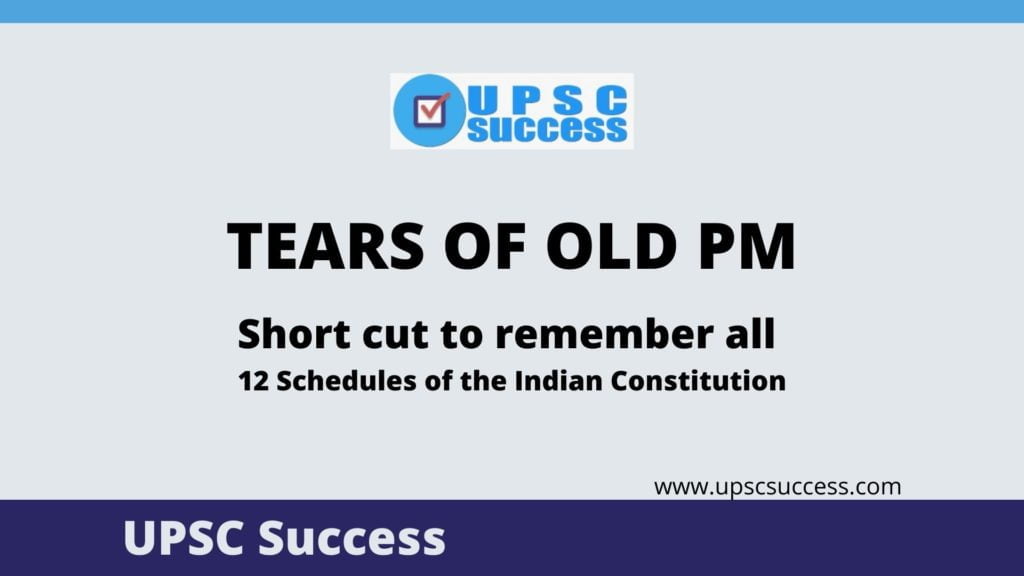
Short cut to remember all 12 Schedules of the Indian Constitution

Shortcut to remember all 12 Schedules of the Indian Constitution

‘TEARS OF OLD PM’

  1. T – Territory
  2. E – Emoluments
  3. A – Affirmation/Oaths
  4. R – Rajya Sabha
  5. S – Scheduled Areas
  6. O – Other Scheduled Areas
  7. F – Federal Provisions (3 lists)
  8. O – Official Languages
  9. L – Land reforms
  10. D – Defection
  11. P – Panchayats
  12. M – Municipalities

Fifth Schedule

The 10 States of Andhra Pradesh, Chhattisgarh, Gujarat, Himachal Pradesh, Jharkhand, Madhya Pradesh, Maharashtra, Odisha, Rajasthan and Telangana have Fifth Schedule Areas.

Article 339: The President appoints a Commission for SA. (Dhebhar Commission (1960) and
D.S Bhuria Commission (2002))

Criteria for Declaration of any area as Scheduled Area (Dhebar Commission)

  • Preponderance of tribal population
  • Compactness and reasonable size of the area,
  • Viable administrative entity such as a district, block or taluk.
  • Economic backwardness of the area as compared to the neighbouring areas.

Provisions:

  • President declare SA + increase/decrease area, alter boundary, redefine area (in consultation with Governor)
  • Executive power of the State extends to these areas + Centre executive power
  • Giving directions to the State for administration of SA
  • Tribes Advisory Council: setup in SA & also where significant tribe(if president directs) + max 20 members (¾ ST representative in SLA) + Governor may make rules Regarding the number of Council Members, appointment of chairman etc.
  • Governor has enormous legislative powers: Submit report annually to President + can direct that any particular act of Parliament or legislature does not apply to SA or apply with modification.
  • Governor + TAC (with President Assent): may make regulations to restrict or prohibit transfer of land + allotment of land + moneylending + repeal or amend Parliament/Legislature Act.
  • Fifth Schedule Areas are exempt from the Panchayat-related requirements of Part IX of the constitution. PESA Act, 1996, was passed to extend provisions of Part IX to the fifth Scheduled area.

Provisions in the Fifth Schedule may be amended, altered, or repealed by Parliament (but not under Ar 368)


Sixth Schedule

To govern the tribal areas of Assam, Meghalaya, Tripura and Mizoram.

Provisions:

  • Tribal areas to be administered as Autonomous Districts(AD) + If different ST in autonomous district. Governor can divide district inhabited by them into Autonomous Regions(AR)
  • Governor: organise/reorganise/increase/decrease the boundaries/alter name of autonomous district.
  • Parliament or Legislature Act do not apply or apply with modifications in AD & AR.
  • District Councils (for AD) and Regional Councils(for AR)
  • District Council: Max 30 Members → 26(Elected) + 4(Nominated by Governor)
  • With Governor's assent - can make laws on lands, forest management (except Reserved Forest), inheritance of property, and money-lending.
  • DC & RC can constitute Village and District Council Courts → HC & SC has further jurisdiction.
  • DC & RC can collect land revenue; impose taxes; and grant licences for the extraction of minerals.
  • DC & RC can manage primary schools, dispensaries, markets, roads, ponds etc.
  • Governor appoints commission.
  • Area ⇒ 3+3+3+1 (1) in Tripura
StateArea
Assam (3)North Cachar Hills District
Karbi Anglong District
Bodoland Territorial Areas District
Tripura (1)Tripura Tribal Areas District
Meghalaya (3)Garo Hills District
Khasi Hills District
Jaintia Hills District
Mizoram (3)Chakma District
Mara District
Lai District

Indian Constitution:

Chapter 3

Borrowed Features Of Indian Constitution

Part List Part I - IVA Part VPart VI-X Part XI- XVI Part XVII- XXII Borrowed Features Of Indian Constitution From United Kingdom (UK) Below is the lis...
• Key concept: Borrowed Features Of Indian Constitution • Essential for UPSC CSE Prelims, State PSCs, SSC CGL & Railway exams. • Comprehensive analytical coverage and factual pointers provided below.

Borrowed Features Of Indian Constitution

From United Kingdom (UK)

Below is the list of features borrowed from the constitution of United Kingdom (UK)

  • Nominal Head – President (like Queen)
  • Cabinet System of Ministers
  • Post of PM
  • Parliamentary Type of Govt.
  • Bicameral Parliament
  • Lower House more powerful
  • Council of Ministers responsible to Lowe House
  • Speaker in Lok Sabha

From United States Of America (U.S.A)

  • Written Constitution
  • Executive head of state known as President and his being the Supreme Commander of the Armed Forces
  • Vice- President as the ex-officio Chairman of Rajya Sabha
  • Fundamental Rights
  • Supreme Court
  • Provision of States
  • Independence of Judiciary and judicial review
  • Preamble
  • Removal of the Supreme court and High court Judges

From Union of Soviet Socialist Republics (USSR)

  • Fundamental Duties
  • Five-year Plan

From Australia

  • Concurrent list
  • Language of the preamble
  • The provision regarding trade, commerce and intercourse

From Japan

  • Law on which the Supreme Court function

From Weimer Constitution Of Germany

  • Suspension of Fundamental Rights during the emergency

From Canada

  • Scheme of federation with a strong centre
  • Distribution of powers between the centre and the states and placing. Residuary Powers with the centre

From Ireland

  • Concept of Directive Principles of State’s Policy(Ireland borrowed it from SPAIN)
  • Method of election of President
  • The nomination of members in the Rajya Sabha by the President

From South Africa

  • Amendment Of the Indian Constitution
Chapter 4

List of Recognised Languages

The Constitutional provisions relating to the Eighth Schedule occur in articles 344(1) and 351 of the Constitution. The Eighth Schedule was intended to pro...
• Key concept: List of Recognised Languages • Essential for UPSC CSE Prelims, State PSCs, SSC CGL & Railway exams. • Comprehensive analytical coverage and factual pointers provided below.

The Constitutional provisions relating to the Eighth Schedule occur in articles 344(1) and 351 of the Constitution. The Eighth Schedule was intended to promote the progressing use of Hindi.
 
List of languages in the Eighth Schedule:
The Eighth Schedule to the Constitution consists of the following 22 languages:-

Language Font
AssameseAssamese
BengaliBengali
GujaratiGujarati
HindiDevanagari
KannadaKannada
KashmiriPersian
KonkaniDevanagari
MalayalamMalayalam
ManipuriBengali
MarathiDevanagari
NepaliDevanagari
OriyaOriya
PunjabiGurumukhi
SanskritDevanagari
SindhiDevanagari or Arabic
TamilTamil
TeluguTelugu
UrduPersian
BodoDevanagari
DogriDevanagari
MaithilliDevanagari
SanthaliDevanagari or Olchiki

The first 14 languages with initially included in the Constitution and others were added later on. The Sindhi language was added in 1967. Thereafter three more languages viz., Konkani, Manipuri and Nepali were included in 1992. Subsequently, Bodo, Dogri, Maithili and Santhali were added in 2004.

Further Demands:

There has been growing demands from various factions for inclusions of regional languages. The following 38 languages has been suggested.
(1) Angika, (2) Banjara, (3) Bazika, (4) Bhojpuri, (5) Bhoti, (6) Bhotia, (7) Bundelkhandi (8) Chhattisgarhi, (9) Dhatki, (10) English, (11) Garhwali (Pahari), (12) Gondi, (13) Gujjar/Gujjari (14) Ho, (15) Kachachhi, (16) Kamtapuri, (17) Karbi, (18) Khasi, (19) Kodava (Coorg), (20) Kok Barak, (21) Kumaoni (Pahari), (22) Kurak, (23) Kurmali, (24) Lepcha, (25) Limbu, (26) Mizo (Lushai), (27) Magahi, (28) Mundari, (29) Nagpuri, (30) Nicobarese, (31) Pahari (Himachali), (32) Pali, (33) Rajasthani, (34) Sambalpuri/Kosali, (35) Shaurseni (Prakrit), (36) Siraiki, (37) Tenyidi and (38) Tulu.

Chapter 5

Articles related to MPs, MLAs and MLCs

Article 80 The maximum strength of Rajya Sabha to be 250 Out of 250, 12 members are nominated by the President and 238 are representatives of the States an...

• Key concept: Articles related to MPs, MLAs and MLCs
• Essential for UPSC CSE Prelims, State PSCs, SSC CGL & Railway exams.
• Comprehensive analytical coverage and factual pointers provided below.

Article 80

  1. The maximum strength of Rajya Sabha to be 250
  2. Out of 250, 12 members are nominated by the President and 238 are representatives of the States and of the two Union Territories.
  3. The members nominated by the President are persons having special knowledge or practical experience in respect

Article 81

  1. Limits the maximum strength of the House of the People or the Lok Sabha to552.
  2. Out of 552, 530 members are elected to represent the States.
  3. Upto 20 members are elected to represent the Union Territories and

Article 331

  1. Not more than 2 members of the Anglo-Indian Community to be nominated by the Hon'ble President to the House of People, if, in his/her opinion, that community is not adequately represented in the House.

Article 170

  1. The number of seats in the Legislative Assembly of each State to consist of not more than 500 and.
  2. Not less than 60, members chosen by direct election from territorial constituencies in the State.

Article 171

  1. The total number of members in the Legislative Council of a State shall not exceed one-third of the total number of members in the Legislative Assembly of that State.
  2. The total number of members in the Legislative Council of a State shall in no case be less than 40.

Article 333

Empowers the Governor to nominate one member of the Anglo-Indian community to the Legislative Assembly of the State if in his opinion the community is not adequately represented therein.
Chapter 6

Indian Polity

The UPSC syllabus for Prelims elaborates on "Indian Polity and Governance - Constitution, Political System, Panchayati Raj, Public Policy, Rights Issues, e...
• Key concept: Indian Polity • Essential for UPSC CSE Prelims, State PSCs, SSC CGL & Railway exams. • Comprehensive analytical coverage and factual pointers provided below.

The UPSC syllabus for Prelims elaborates on "Indian Polity and Governance - Constitution, Political System, Panchayati Raj, Public Policy, Rights Issues, etc.". The Constitution is the most important topic under the Indian Polity. Apart from this, the students should also study new bills, laws, governance issues, etc.

Indian Constitution (basics):

Indian Constitution (Topics in the same order):

Executive

Legislature

- Parliamentary Committees
- Budget

Judiciary

Fundamental Rights

Centre-state Relations:
- NITI Aayog
- National Development Council

Local Government:

Policies, Bills and Acts (Statutes)

Governance

Social Justice:

- Major Tribes in India: State-wise compilation.

Further Reading:

Indian Polity Quiz & Questions

Indian Polity & Constitution Objective Questions for Competitive Exams

Books to Study Indian Polity

  • Indian Polity for Civil Services Examinations by M. Laxmikanth is the most preferred books by students for all stages of competitive examinations in India.
  • Introduction to the Constitution of India by Durga Das Basu – A much more authoritative text on Indian polity. Good reference material for Supreme Court judgments, but beginners may find it tough.
  • Our Parliament by Subhash Kashyap.
  • India Year Book.
  • Class 11 & 12 NCERT textbook of Political Science, especially, the "Indian Constitution at work".
Chapter 7

Preamble of the Constitution

The opening words of the preamble of the Indian Constitution: WE, THE PEOPLE OF INDIA, having solemnly resolved to constitute India into a Sovereign, Socia...
• Key concept: Preamble of the Constitution • Essential for UPSC CSE Prelims, State PSCs, SSC CGL & Railway exams. • Comprehensive analytical coverage and factual pointers provided below.

The opening words of the preamble of the Indian Constitution:

WE, THE PEOPLE OF INDIA, having solemnly resolved to constitute India into a Sovereign, Socialist, Secular Democratic Republic and to secure to all its citizens:
JUSTICE, social, economic and political;
LIBERTY of thought, expression, belief, faith and worship;
EQUALITY of status and of opportunity;
and to promote among them all
FRATERNITY assuring the dignity of the individual and the _2[unity and integrity of the Nation];
IN OUR CONSTITUENT ASSEMBLY this twenty-sixth day of November 1949, do HEREBY ADOPT, ENACT AND GIVE TO OURSELVES THIS CONSTITUTION.

 
The Constitution derives authority from the people (We the people...).  The preamble is non-justifiable.
The Preamble is the introduction to the Constitution. On December 13, 1946, Jawaharlal Nehru moved the historic "Objectives Resolution", and the Constituent Assembly adopted it on January 22, 1947. Our Preamble is based on "Objective Resolution".

The Preamble was amended only once in the year 1976 through the 42nd amendment to add 3 new words: Socialist, Secular, Integrity. An Amendment to preamble would be through Article 368.
There have been questions whether Preamble is part of the constitution? In the year 1960, as per Berubari case, the Supreme Court ruled that Preamble is not a part of Constitution. And in 1973, in the Kesavananda Bharati v. State of Kerala case, the Supreme Court rejected the earlier opinion and held that Preamble is a part of the Constitution. The Court said that the Constitution could not be amended so as to alter the basic elements. The in 1995, in LIC of India v. Consumer Education and Research centre case the Supreme Court again held that the Preamble is an integral part of the Indian Constitution. 

The preamble is part of Indian Constitution after case of “Union of India vs Keshvanand Bharati.

The Components of the Preamble

The Preamble states that the Constitution derives its authority from the people of India.
The preamble specifies the nature of Indian State:
to be of a sovereign, socialist, secular, democratic and republican polity.
The preamble specifies the objectives of the Constitution:
It specifies justice, liberty, equality and fraternity as the objectives.
The date of adoption is mentioned in the Preamble as 26th November 1949.
- The Preamble indicates the source from which the Constitution derived its authority.
- The Preamble also states the objects which the Constitution seeks to establish and promote.
Keywords in the Preamble: Sovereign, Socialist, Secular, Democratic, Republic, Justice, Liberty, Equality and Fraternity

Sovereign

  • The term sovereign means independent state.
  • The country is free to choose its relation with other countries and free to conduct both internal & external affairs.
  • This is the absolute and supreme power.
  • This means that India has the power to legislate on any subject.
  • India is neither dependency nor a dominion of any other nation but an independent state.

In 1949, India did not give off their membership to Commonwealth of Nations and accepted the British Crown as the head of the Commonwealth. This is because the membership did not affect India's sovereignty in any manner.

Socialist

During the Independence, India was in favour of "democratic socialism" and was against the "communistic socialism". "Democratic socialism" means a country where mixed economy exist and have existence all public & private players. "Communistic Socialism" means a country where all the production & distribution be in hands of Government and abolition of all rules related to private property. In India this is the Democratic Socialism.

  • This term was added to the preamble by the 42nd amendment act of 1976.
  • The word socialism means placing means of production and distribution in the hands of public control. (state).
  • The socialism strives to end inequality of opportunity.
  • Socialism also means elimination of inequalities in income and status and standard of living.
  • In India, we have existence of both Public and Private sectors. And this is called mixed economy.

The new economic policy (1991) of Liberalization, Privatization and Globalization (LPG) has diluted the socialist credentials of the Indian State.

Secular

  • This term was added to the preamble by the 42nd Amendment to Indian Constitution in 1976.
  • This means the state has no official religion.
  • Article 25 to 28 of Indian Constitution (guaranteeing the fundamental right to freedom of religion) talked about freedom of religions.
  • 1974, Honorable Supreme Court mentioned that "there can be no doubt that Constitution-makers wanted to establish such a state and accordingly Articles 25 to 28 have been included in the constitution."

Democratic

  • This word comes from Greek work "dēmokratia".Demos = People; Kratia = Rule
  • In Pre­amble this word used in broader sense that contains all Economic, Social and political democracy.
  • Democracy means rule by the people.
  • The people of the country elect their own representatives.
  • In India it is a representative democracy (in­direct). (Democracy is of two types - direct and in­direct.)
  • One man one vote is the concept in democracy.
  • There are of two type democracy in India: Parliamentary and Presidential.

Republic

  • The Head of the state is always elected directly or indirectly for a fixed period.

"What is state?
- This is explained by the Constitution under Articles 12 and 36.
- ARTICLE 12: In this Part (Part III), unless the context otherwise requires, “the State’’ includes the Government and Parliament of India and the Government and the Legislature of each of the States and all local or other authorities within the territory of India or under the control of the Government of India.
- ARTICLE 36: In this Part (Part IV), unless the context otherwise requires, “the State” has the same meaning as in Part III."

  • India has an elected head called the president, and is elected indirectly for a fixed period of five years. The President is elected indirectly through the method of proportional representation by means of a single transferable vote.
  • Every citizen with the qualifications mentioned in the constitution is eligible to contest in the election of the President. All offices including that of the President will be open to all citizens.

Justice

The ideal of justice: social, economic and political, has been taken from the Russian Revolution (1917). Preamble contains Justice and which is further in terms of social, economic and political.

  • Justice is harmonizing the interests between the individuals and between the individuals and groups and the interest of the community.
  • This is not just confined to the legal justice but social, economic and political as well.

Social justice

  • It means equal treatment of all citizens without any social distinction based on caste, colour, race, religion, sex and so on.
  • Article 38 says that the state should strive to promote the welfare of the people.

Economic justice

  • The non-discrimi­nation between people on the basis of economic factors.
  • It involves the elimination of glaring in­equalities in wealth, income and property.
  • Article 39: Certain principles of policy to be followed by the state. (equal pay for equal work)

Political justice

  • All citizens should have equal political rights, equal ac­cess to all political offices and equal voice in the government.
  • Irrespective of propriety or educational qualifications, every citizen is allowed to participate in the political system.
  • All citizens have the right to participate in the political process.
  • Articles 325 and 326 provide for the equal rights of all adults to participate in elections.
    ARTICLE 325: No person to be ineligible for inclusion in or to claim to be included in a special, electoral rolls on grounds of religion, race, caste or sex.
    ARTICLE 326: Elections to the House of People (Lok Sabha) and to the legislative assemblies of states to be on the basis of adult franchise.

Liberty

  • This word is taken from the French Revolution (1789-1799).
  • The Preamble secures liberty of thought, expression. belief, faith and worship to all the citizens of India.
  • Article 19 guarantees the freedom of speech, expression etc.\
  • Articles 25 to 28 (right to religion) of the constitution the freedom of religion including the belief, faith and worship.
  • All Fundamental Rights rights are granted with the reasonable restrictions.

Equality

  • This word is taken from the French Revolution (1789-1799).
  • All citizens enjoy equal political rights.
  • All citizens are equal before the law and enjoy equal protection of the law of the land.
  • There can be no discrimination between one person and another on the grounds of religion, race, caste, sex, place of birth in matters related to access to public places and public employment.

1. Equality before law is borrowed from UK
2. Equal protection of Laws borrowed from the USA.
Fundamental Rights includes following Articles:

  • Equality before the law (Article 14).
  • Prohibition of discrimination on grounds of religion, race, caste, sex or place of birth (Article 15).
  • Equality of opportunity in matters of pub­lic employment (Article 16).
  • Abolition of Untouchability (Article 17).
  • Abolition of titles (Article 18).

Fraternity

The last three words i.e. liberty, equality and fraternity in our Preamble have been taken from the French Revolution (1789-1799).

  • Fraternity means a sense of brotherhood among all the citizens.
  • The Constitution promotes this feeling of fraternity by the system of single citizenship.
  • The fundamental rights that are guaranteed also promote the fraternity.
  • The Directive Principles of State Policy talks about the promotion of harmony.
  • The objective of the Dignity of the individual was to improve the quality of life for the individuals.
  • The unity and integrity of the nation is possible through the dignity of the individual.
  • The Fundamental Duties (Article 51-A) say that it shall be the duty of every citizen of India to promote harmony and the spirit of common brotherhood among all the people of India transcending religious, linguistic, regional or sectional diversities.
Chapter 8

UPPSC Syllabus

UPPSC Syllabus for Preliminary and Main exams. For complete details about UPPSC, please click here UPPSC Preliminary examination syllabus PAPER -I (200 mar...

• Key concept: UPPSC Syllabus
• Essential for UPSC CSE Prelims, State PSCs, SSC CGL & Railway exams.
• Comprehensive analytical coverage and factual pointers provided below.

UPPSC Syllabus for Preliminary and Main exams. For complete details about UPPSC, please click here

UPPSC Preliminary examination syllabus


PAPER -I (200 marks) Duration: Two hours

  • Current events of national and international importance.

  • History of India and Indian National Movement.

  • Indian and World: Geography-Physical, Social, Economic geography of India and the World.

  • Indian Polity and Governance – Constitution, Political System, Panchayati Raj, Public Policy, Rights issues, etc.

  • Economic and Social Development – Sustainable Development Poverty Inclusion, Demographics, Social Sector Initiatives, etc.

  • General Issues on Environmental Ecology, Bio-diversity and Climate Change- that do not require subject specialization.

  • General Science


PAPER-II (200 marks) Duration: Two hours

  • Comprehension

  • Interpersonal skills including communication skills.

  • Logical reasoning and analytical ability.

  • Decision-making and problem-solving.

  • General mental ability

  • Elementary Mathematics up to Class X level- Arithmetic, Algebra, Geometry, and Statistics.

  • General English up to Class X level.

  • General Hindi up to Class X level


UPPSC Main Exam Syllabus


GENERAL STUDIES, PAPER- I

  • History of India-Ancient, Mediaeval, Modern

  • Indian National Movement and Indian Culture

  • Population, Environment, and Urbanization in Indian Context

  • World Geography, Geography of India and its natural resources.

  • Current events of national and international importance.

  • Indian Agriculture, Trade, and Commerce.

  • Specific knowledge of U.P. regarding education, culture Agriculture, Trade Commerce, The methods of living and Social Customs. History of India and Indian culture will cover the broad history of the country from about the middle of the nineteenth century and would also include questions on Gandhi, Tagore, and Nehru. The part on current events of national and international importance will include items also on sports and games.


GENERAL STUDIES: PAPER – II

  • Indian Polity,

  • Indian Economy

  • General Science (Role of Science and Technology in the development of India including science in everyday life)

  • General Mental ability. 5. Statistical Analysis, Graphs, and Diagrams.

  • The part relating to the Indian polity will include questions on the political system in India and Indian constitution. The Indian economy will cover full features of economic policy in India. The part relating to role and impact of science and technology in the development of India, questions will be asked to test the candidate’s awareness in this field Emphasis will be on the applied aspects. The part relating to statistical analysis, graphs and diagrams will include exercise to test the candidate’s ability to draw common sense conclusions from information presented in statistical graphical or diagrammatical form and to point out deficiencies limitation or inconsistencies therein.


ZOOLOGY:
PAPER- I

  • NonChordate, Chordate, Ecology, Ethology, Biostatistics and Economic Zoology.


SECTION A-NON-CHORDATA AND CHORDATA


  • General Survey: Classification and Interrelationship of various Phyla.

  • Protozoa: Locomotion, Nutrition, Reproduction and Human Parasite.

  • Proofers: Canal system; Skeleton and Reproduction

  • Cridaris: Polymorphism; Coral reels Mutagenesis.

  • Helminthiases: Parasitic adaptation and host-parasite relationships.

  • Annelida: Adaptive radiation in Polychaeta.

  • Arthropoda: Larval forms and parasitism in Crustacea. Appendages of prawn: Vision and respiration in Arthropod, Social life and metamorphosis in insects.

  • Mollusca: Respiration, Pearl formation.

  • Echinodermata: General organization, larval forms, and affinities.

  • Chordate: Origin: Lungfishes; Origin Of tetrapods.

  • Amphibious: Neoteny and parental care.


SECTION-B: Ecology, Ethology, Biostatics and Economic Zoology.

  • Ecology: Abiotic and biotic factors; Inter and intraspecific relations, ecological succession; Different types of biomes; biogeochemical cycles. Food web; Ozone layer and Biosphere; Pollution of air, water, and land.

  • Ethology: Types of animal behaviour, Role of hormones and pheromones in behaviour; Methods of studying animal behaviour, Biological rhythms

  • Biostatistics: Sampling methods, frequency distribution, and measures of central tendency, standard deviation, standard error correlation and regression chi-square and t-test.

  • Economic Zoology: Insect pests of crops (Paddy, Gram, and Sugarcane) and stored grains, Agriculture, Sericulture, Lac culture, pisciculture and Oyster culture


Paper II

  • Cell Biology Genetics, Evolution, and Systematics, Bio-Chemistry, Physiology and Development Biology.


CHEMISTRY:
PAPER- I

  • Atomic Structure

  • Nuclear and Radiation Chemistry

  • Molecular Spectra

  • Electrochemistry

  • Chemical Kinetics

  • Chemical Thermodynamics

  • Surface Chemistry


PAPER- II

  • General Organic Chemistry

  • Aliphatic Compounds

  • Carbohydrates

  • Stereochemistry and conformations

  • Aromatic Compounds

  • Naphthalene & Pyridine

  • Chemistry of Living Cells

  • NMR Spectroscopy

  • Chromatography

  • Environmental Chemistry


PHYSICS:
PAPER – I: Mechanics, Thermal Physics and Waves & Oscillations

  • Mechanics

  • Thermal Physics

  • Waves of Oscillations


PAPER – II: Electricity and Magnetism, Modern Physics and Electronics

  • Electricity and Magnetism

  • Modern Physics

  • Electronics


MATHEMATICS
PAPER- I

  • Linear Algebra

  • Calculus

  • Analytical Geometry of two and three dimensions

  • Differential Equations

  • Vector Analysis

  • Tensor Analysis

  • Dynamics

  • Hydrostatics


PAPER II

  • Algebra

  • Real Analysis

  • Complex Analysis

  • Partial Differential Equations

  • Mechanics

  • Numerical Analysis

  • Numerical Integration of Ordinary Differential Equations

  • Operational Research


GEOGRAPHY: PAPER -1- SECTION -A-PHYSICAL GEOGRAPHY

  • Geomorphology

  • Climatology

  • Oceanography

  • Soil and Vegetation

  • Ecosystem


SECTION B: HUMAN GEOGRAPHY

  • Evolution of Geography Thought

  • Human Geography

  • Settlement Geography

  • Economic Geography

Chapter 9

HIGH COURT

The High Court occupies the top position in the judicial administration of state. The first High Courts were set up in India in Calcutta, Bombay and Madras...
• Key concept: HIGH COURT • Essential for UPSC CSE Prelims, State PSCs, SSC CGL & Railway exams. • Comprehensive analytical coverage and factual pointers provided below.

The High Court occupies the top position in the judicial administration of state.

The first High Courts were set up in India in Calcutta, Bombay and Madras in 1862.

In the year 1866 the fourth High Court was set up in Allahabad.

The 7th amendment (1956) Act authorized the Parliament to establish a common High Court for 2 or more states.

At present there are 24 High Courts in the country.

The Security of tenure is provided to the judges of High Courts by the Constitution. This means the judges of High Court can be removed by the President only in the manner and on the grounds mentioned in the Constitution.

The Judges of the High Court do not hold the office during the pleasure of the President.

So far how many judges of High Court have been removed?

No High Court judge was removed so far in independent India.

The salaries, allowances and pensions of the High Court judges are determined from time to time by the Parliament.

QUALIFICATIONS OF JUDGES OF THE HIGH COURT:

Should be a citizen of India.

Should have held a judicial office in the territory of India for 10 years.

                                   (OR)

Should have been an advocate of a High Court for ten (10) years.

APPOINTMENT OF JUDGES:

The judges of the High Court are appointed by the President.

The Chief Justice (CJ) is appointed by the President after consultation with the CJI and the Governor of the concerned state.

In case of common High Court for 2 or more states the Governors of all the states are concerned by the President.

OATH:

Oath of office is administered by the Governor of the concerned state.

In the absence of the Governor some other person appointed by the President would perform the same.

TENURE (TERM):

A judge of High Court holds the office till he/she attains the age of 62 years.

Note: Through 15th Amendment Act of 1963 the retirement age of the High Court judges has been increased from 60 to 62 years.

SALARY:

Determined by the Parliament from time to time.

At present the salary of the Chief Justice of High Court Rs. 90,000/- (Ninety Thousands).

The Salary of other Judge of the High Court is 80,000/- (Eighty Thousands).

The salaries of the High Court judges are charged on the Consolidated Fund of the state.

(Note: Salaries decided by the Parliament and given by the states).

PENSION:

The Pension of the High Court judges is charged on the Consolidated Fund of India and not by the state.

Note: Salaries are paid by the States and pension by the Central Government.

Note: For Supreme Court both the salary and the pension is paid by the central government.

RESIGNATION:

A judge of High Court submits the resignation to the President of India.

IMPEACHMENT

A judge can be removed from the office by the President on the recommendation by the Parliament.

(Removed in the same manner like that of a Supreme Court).

Note: Please go through Supreme Court.

TRANSFER OF JUDGES:

The President can transfer a judge from one High Court to another after consulting the CJI (Chief Justice of India).

MISCELLANEOUS:

High Court is the highest Court of appeal in the state.

The High Court is the protector of Fundamental Rights of the citizens.

The High Courts are vested with the power to interpret the Constitution but the final interpreter is the Supreme Court.

In the absence of the CJ the President can appoint a judge of a High Court as an acting Chief Justice of the High Court.

The CJ can request a retired judge of that High Court or any High Court to act as a judge of the High Court for a temporary period of time.

The High Court is also a court of records. The judgments of the High Court are admitted to be of evidentiary value and cannot be questioned when produced before any subordinate court. Secondly, the High Court has also got the power to punish for the contempt of court.

The Judicial review is the power of the High Court to examine the constitutionality of legislative enactments and executive orders of both the central and state governments.

The judicial review is needed to uphold the principle of the supremacy of the Constitution, to maintain the concept of federalism (balance between the central and state governments) and also to protect the fundamental rights of the citizens.

The High Court has the power to review its own judgment or order.

(Note: The Supreme Court is the ultimate interpreter of the Constitution).

MISCELLANEOUS:

The names of Bombay, Calcutta and Madras are changed to Mumbai, Kolkata and Chennai respectively, the names of the respective High Courts are not changed).

JANUARY 29, 2013: VISHWAROOPAM: A movie that stars Kamal Hasan was banned in Tamil Nadu by the Government on the account of threat of demonstrations and processions and threats of violence. Madras High Court lifts ban on January 29, 2013 and permitted the screening of the movie.

Controversy: The courts exist principally to dispense justice, not to hand out advice which in the case of Vishwaroopam seems entirely gratuitous (unwarranted) (A day before the Madras HC advised Kamal Hasan to settle the issue with the Government). In the year 2011 the SC set aside the 2 month ban on the Hindi film ‘Aarakshan’ on the ground that the states cannot proscribe films that have been cleared by the CBFC (Central Board of Film Certification) on the mere apprehensions that screening them may cause a law and order problem. SC held that the freedom of expression cannot be suppressed on account of threat of demonstrations and processions and threat of violence.

Chapter 10

Lal Krishna Advani: Bharat Ratna Recipient in 2024

Lal Krishna Advani, a veteran leader of Indian politics and a key figure in the Bharatiya Janata Party (BJP), was awarded the prestigious Bharat Ratna in 2...
• Key concept: Lal Krishna Advani: Bharat Ratna Recipient in 2024 • Essential for UPSC CSE Prelims, State PSCs, SSC CGL & Railway exams. • Comprehensive analytical coverage and factual pointers provided below.

Lal Krishna Advani, a veteran leader of Indian politics and a key figure in the Bharatiya Janata Party (BJP), was awarded the prestigious Bharat Ratna in 2024, recognizing his significant contributions to the nation.

Early Life and Political Entry

  • Born in 1927 in Karachi (now Pakistan).
  • Actively involved in the Rashtriya Swayamsevak Sangh (RSS) since his youth.
  • Joined the Bharatiya Jana Sangh (BJS) in 1951, the precursor to the BJP.
  • Elected to Lok Sabha in 1967, marking his parliamentary debut.

Political Rise and Key Roles:

  • Served as President of the BJP from 1986 to 1990 and 1993 to 1998.
  • Played a crucial role in building the BJP as a national force, leading the party's Rath Yatra in 1990.
  • Deputy Prime Minister in the Atal Bihari Vajpayee-led NDA government from 1998 to 2004, handling key portfolios like Home Affairs and Information & Broadcasting.
  • Led the opposition in the Lok Sabha from 2004 to 2009.

Significant Contributions:

  • Instrumental in shaping the BJP's ideology and strategy, advocating for Hindutva and nationalism.
  • Oversaw key initiatives like the National Highway Development Project and Kargil War victory during his tenure as Deputy Prime Minister.
  • Recognized for his oratorical skills and strategic leadership within the BJP.

Controversies and Criticisms:

  • Associated with the Ayodhya Ram Janmabhoomi movement, which remains a contentious issue.
  • Criticized for his role in the demolition of the Babri Masjid in 1992.
  • Accused of promoting communal politics and divisive rhetoric.

Legacy and Significance for UPSC Aspirants:

  • Advani's political journey offers insights into the evolution of the BJP and its rise to power.
  • Understanding his contributions and controversies is crucial for analyzing Indian politics and social dynamics.
  • His life can be studied as a case study in leadership, ideology, and the complexities of Indian democracy.
Chapter 11

The Paramara Dynasty: History, Administration, and Cultural Contributions

The Paramara Dynasty (9th–14th Century CE) was a powerful Rajput clan that ruled the Malwa region in Central India. Known for their patronage of art, liter...
• Key concept: The Paramara Dynasty: History, Administration, and Cultural Contributions • Essential for UPSC CSE Prelims, State PSCs, SSC CGL & Railway exams. • Comprehensive analytical coverage and factual pointers provided below.

The Paramara Dynasty (9th–14th Century CE) was a powerful Rajput clan that ruled the Malwa region in Central India. Known for their patronage of art, literature, and temple architecture, they played a pivotal role in the resistance against early Islamic invasions.

CategoryDetails
RegionMalwa (Modern Western Madhya Pradesh)
CapitalDhara (Modern Dhar)
First Independent RulerSiyaka II (Harsha)
Most Famous RulerRaja Bhoja (Bhoja I)
Architecture StyleMaru-Gurjara & Bhumija style
Final DeclineAnnexed by Alauddin Khalji (1305 CE)
Political Status:Started as feudatories of the Rashtrakutas before becoming a sovereign power.


Chronological History of Paramara Rulers

1. Upendra (c. 800 – 818 CE)

  • The Founder: Established the dynasty in the Malwa region.
  • Geopolitics: The kingdom was situated to the west of the Kalachuri dynasty. During this period, the Paramaras ruled as vassals to the Rashtrakuta Empire.

2. Siyaka II / Harsha (c. 948 – 972 CE)

  • Independence: The real history of the Paramara dynasty as a sovereign power begins with Siyaka.
  • Expansion: Taking advantage of the death of Rashtrakuta King Krishna III, he declared independence and sacked the Rashtrakuta capital, Manyakheta.
  • Territory: He secured large portions of territory from both the Pratihara and Rashtrakuta empires.

3. Vakpati Munja (c. 972 – 995 CE)

  • The Warrior King: Munja was the most glamorous king of the dynasty, celebrated for his gallantry in local ballads.
  • Military Campaigns: He was a fierce warrior who launched an aggressive campaign against the Western Chalukya King Taila II.
  • Tragic End: Despite his military brilliance, he was eventually entrapped by Taila II and put to death in 995 CE.

4. Sindhuraja (c. 995 – 1010 CE)

  • The Restorer: The younger brother of Munja, Sindhuraja successfully recovered the territories lost to Taila II.
  • Literary Fame: His life is immortalized in the Navasahasanka-charita by the court poet Padmagupta.

5. Raja Bhoja I (1010 – 1055 CE)

  • The Polymath: Successor to Sindhuraja, Bhoja is the most famous Paramara ruler. He was a scholar, builder, and conqueror.
  • Literary Works:
    • Samaranganasutradhara: A classic work on art, architecture (Vastu Shastra), and engineering.
    • Commentary on Yogasutras: A brief but profound commentary on Patanjali’s Yogasutras showcasing his erudition.
  • Cultural Contributions:
    • Founded the city of Bhojapura.
    • Patronized "Men of Letters" like Dhanapala and Uvata.
    • Established the Bhojshala at Dhara for Sanskrit studies.

6. Udayaditya (c. 1060 – 1086 CE)

  • The Builder: Brother of Bhoja and successor to Jayasimha.
  • Architecture: He is credited with the construction of the famous Nilakantesvara Temple at Udayapur (in Bhilsa). This temple is the pinnacle of the Bhumija style of architecture.

7. Mahlak Deo (The Last Ruler)

  • The Fall: The last known king of the Paramaras.
  • Defeat: He faced the invasion of Alauddin Khalji’s forces.
  • Legacy: In 1305 CE, Mahlak Deo was executed, and the Malwa region was annexed into the Delhi Sultanate.

Literary and Cultural Contributions

UPSC frequently focuses on the "Men of Letters" associated with royal courts.

  • Raja Bhoja’s Works:
    • Samaranganasutradhara: A classic treatise on civil engineering and Vastu Shastra.
    • Sarasvatikanthabharana: A work on Sanskrit grammar and poetics.
    • Yogavartika: A commentary on Patanjali’s Yoga Sutras.
  • Court Scholars:
    • Dhanapala: Author of Tilaka-Manjari.
    • Padmagupta: Wrote Navasahasanka-charita (biography of Sindhuraja).

Architecture: The Udayeshwara Temple

Under Udayaditya, the dynasty saw the construction of the Nilakantesvara (Udayeshwara) Temple at Udaipur. It is a masterpiece of the Bhumija style of Nagara architecture, characterized by its unique miniature spires on the Shikhara.

Literary Works

AuthorWorkSubject
Raja BhojaSamaranganasutradharaArchitecture/Vastu
Raja BhojaSarasvatikanthabharanaGrammar/Poetics
PadmaguptaNavasahasanka-charitaBiography of Sindhuraja
DhanapalaTilaka-ManjariProse Romance

The Decline of the Paramaras

The dynasty faced constant pressure from the Solankis of Gujarat and the Yadavas of Devagiri.

  • Mahlak Deo: The last known ruler.
  • 1305 CE: Alauddin Khalji’s general, Ain-ul-Mulk Multani, defeated Mahlak Deo. Malwa was subsequently annexed into the Delhi Sultanate.+1

FAQs for UPSC Students

Who was the author of 'Navasahasanka-charita' and what is its significance?

It was written by Padmagupta. It is the earliest available Sanskrit historical mahakavya of the Paramara dynasty, focusing on the life of King Sindhuraja.

What is the 'Bhumija' style of architecture associated with the Paramaras?

The Bhumija style is a subtype of Nagara architecture developed in Malwa. It features a central projection on each side of the Shikhara, decorated with rows of miniature Shikharas (Urushringas).

How did the geography of Malwa influence the Paramara economy?

Malwa was a fertile plateau situated on the trade routes connecting Northern India to the Deccan and the Western coast. This led to a prosperous economy based on both agriculture and trade-taxation.

Who built the Bhojshala in Dhar?

Raja Bhoja built the Bhojshala as a temple to Goddess Saraswati and a major center for higher learning in Sanskrit. It remains a site of historical and archaeological significance today.

Which style of temple architecture is unique to the Paramara dynasty?

The Bhumija style (a subtype of Nagara architecture) is uniquely associated with the Paramaras, characterized by the miniature spires arranged in rows on the main Shikhara.

Who wrote 'Samaranganasutradhara' and what is its subject?

It was written by Raja Bhoja I. It is a comprehensive treatise on Indo-Aryan architecture, town planning, and even mechanical devices (Yantras).

What was the capital of the Paramara Dynasty?

The capital was Dhara (Modern Dhar, Madhya Pradesh). It became a major center for Sanskrit learning under Raja Bhoja.


Chapter 12

COBOL Programming Language: Legacy Systems and Modern Relevance

In the evolving landscape of Science and Technology (GS Paper III), the UPSC frequently pivots from cutting-edge innovations like Quantum Computing to the ...
• Key concept: COBOL Programming Language: Legacy Systems and Modern Relevance • Essential for UPSC CSE Prelims, State PSCs, SSC CGL & Railway exams. • Comprehensive analytical coverage and factual pointers provided below.

In the evolving landscape of Science and Technology (GS Paper III), the UPSC frequently pivots from cutting-edge innovations like Quantum Computing to the "invisible" foundations of our digital economy. One such foundation is COBOL (Common Business-Oriented Language).

Despite being developed in 1959, COBOL remains the backbone of global and Indian financial architecture. Recently, the technology has regained the spotlight due to advancements in Artificial Intelligence (AI), specifically claims by AI labs like Anthropic regarding the modernization of legacy code.

What is COBOL?

COBOL is a high-level, compiled programming language designed specifically for business, finance, and administrative systems for companies and governments.

  • Acronym: Common Business-Oriented Language.
  • Nature: It is a "procedural" and "imperative" language, known for its English-like syntax, making it readable for non-technical managers.
  • Primary Platform: It primarily runs on Mainframe Computers, which are high-performance computers used for large-scale data processing.

The Role of COBOL in the Indian Economy

For a UPSC aspirant, understanding the application of technology is more crucial than the syntax. In India, COBOL serves three primary sectors:

1. The Banking Sector (The Financial Backbone)

Most Public Sector Banks (PSBs), including the State Bank of India (SBI), rely on legacy mainframe systems for their Core Banking Solutions (CBS).

  • Transaction Processing: When you initiate an IMPS or NEFT transfer, the backend reconciliation often occurs on COBOL-based systems.
  • ATM Operations: Handling the high volume of daily withdrawals and balance updates.

2. Insurance and Pensions

The Life Insurance Corporation of India (LIC) and various government pension portals manage massive datasets.

  • Policy Management: COBOL is used to handle millions of policy records, premium calculations, and long-term claim settlements where reliability is non-negotiable.

3. Government Databases

Administrative systems involving payroll processing for massive workforces (like the Indian Railways) and legacy pension records continue to utilize COBOL for its stability and ability to handle "Big Data" before the term even existed.


Why is COBOL in the News? (The AI Connection)

The "Y2K" scare was the last time COBOL was a household name. However, in 2025-2026, the narrative has shifted to AI-driven Legacy Modernization.

  • The Problem: There is a critical shortage of COBOL programmers (the "Silver Tsunami"), making these systems hard to maintain.
  • The AI Solution: The AI company Anthropic recently demonstrated that its tool, Claude Code, can understand, debug, and even migrate COBOL code to modern languages like Java or Python.
  • Significance: This reduces the operational risk for banks and government departments, allowing them to modernize without the fear of a total system collapse.

Comparison: Legacy vs. Modern Systems

FeatureCOBOL (Legacy)Python/Java (Modern)
Primary UseHigh-volume batch processingWeb, Mobile, & AI Apps
ReadabilityHigh (English-like)Moderate (Symbol-heavy)
PerformanceExcellent for file handlingVersatile across platforms
ModernizationDifficult/ExpensiveNative/Cloud-ready

UPSC Perspective

In GS Paper III (IT & Computers), the focus is on "Awareness in the fields of IT." COBOL is a classic example of Legacy Infrastructure. Candidates should understand that technology in governance isn't just about the "new" (5G/AI) but also about maintaining and securing the "old" that keeps the economy running.


Prelims & Mains Pointer

Prelims Quick Facts

  • Origin: 1959 (One of the oldest high-level languages).
  • Key Strength: High-speed processing of large-scale business data.
  • Status: Not obsolete; manages an estimated 80% of daily global business transactions.

Potential Prelims Question

Q. With reference to 'COBOL', which was recently in the news, consider the following statements:

  1. It is a programming language primarily used in decentralized finance and blockchain.
  2. It remains a critical component of the backend systems of many global and Indian banks.
  3. Modern AI tools are being developed to translate COBOL into newer programming languages.

Which of the statements given above is/are correct?

(a) 1 and 2 only

(b) 2 and 3 only

(c) 3 only

(d) 1, 2, and 3

Answer: (b) (Statement 1 is incorrect; COBOL is used in centralized legacy systems, not typically in Blockchain).

Potential Mains Question (GS-III)

"The dependence of critical financial infrastructure on legacy programming languages like COBOL presents both a stability strength and a cybersecurity risk. Discuss in the context of India's digital transformation."