coastal plains in India The coastline of India is about 7517 Km long.6100 km of mainland coastline and 1417 km of Indian islands.13 States and UTs have coa...
• Key concept: Coastal Plains in India
• Essential for UPSC CSE Prelims, State PSCs, SSC CGL & Railway exams.
• Comprehensive analytical coverage and factual pointers provided below.
coastal plains in India
The coastline of India is about 7517 Km long.
6100 km of mainland coastline and 1417 km of Indian islands.
13 States and UTs have coastal plains in India
The coastline of the India States & UTs wise:
Gujarat – 1215 Km
Andhra Pradesh – 974Km
Tamil Nadu – 907 Km
Maharashtra – 652.6 Km
Kerala – 569.7 Km
Odisha – 476.4 Km
Karnataka – 280 Km
Goa (with Daman & Diu) – 160.5 Km
WestBengal – 157.5 Km
Puducherry – 30.6 Km (UT)
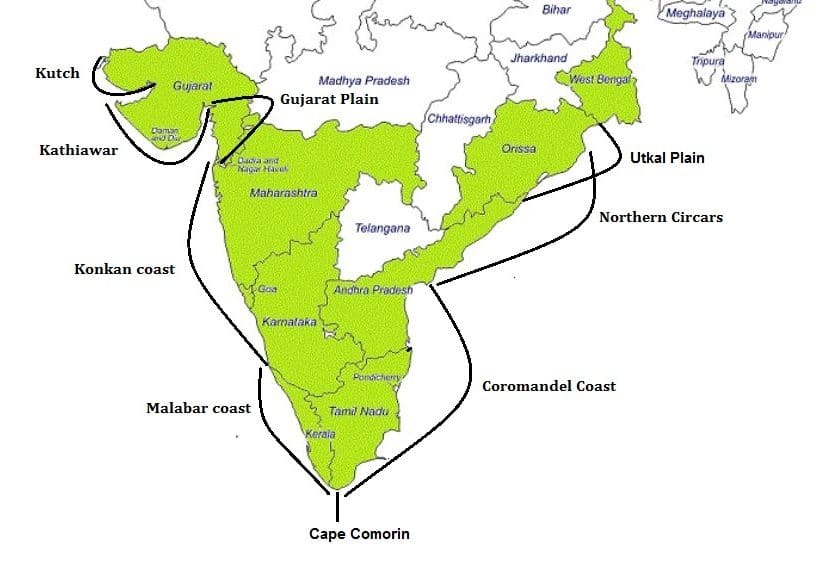
Western Coastline of India
Kutch and Kathiawar coast
Gujarat Plain
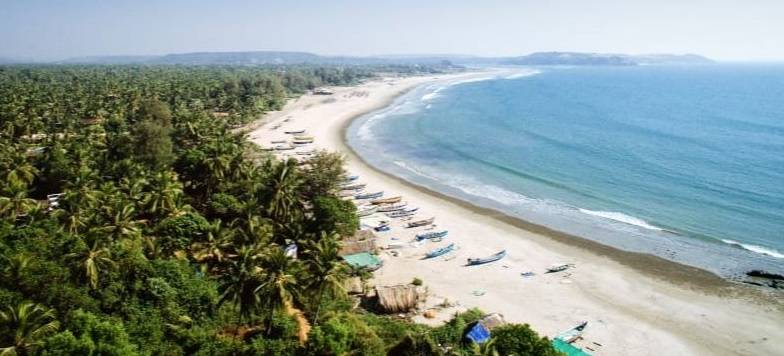
Konkan coast
Goan coast
Malabar coast
Eastern Coastline of India
Utkal Plain
Andhra Plain
Coromandel Coast
Western Coastal Plains of India
It extends from Rannof Kutch in the north to CapeComorin (Kanniyakumari).
Western coastal plains in India are an example of a submergedcoastalplain.
Because of this submergence, it is a narrowbelt with an averagewidth of about65km
It provides natural conditions for the development of ports and harbors.
Kandla, Mazagaon, JLN port Navha Sheva, Marmagao, Mangalore, Cochin, etc. are some important natural ports located along the west coast.
Western coastal plains of India are narrow in the middle and get broader towards the north and south.
Rivers flowing through this coastal plain donotform any delta but a few estuaries.
The estuaries of the Narmada and the Tapi are important.
Kutch & Kathiawar Coast
Kutch Coast is an extension of the Peninsular plateau (made of the Deccan Lava).
It is treated as part of the Western coastal plains of India as they are now levelled down.
The Kutch Peninsula was an island surrounded by seas and Kutch lagoons.
These seas and lagoons were later filled by sediment brought by the Indus River which used to flow through this area.
Lack of rains in recent times has turned it into an arid and semi-arid landscape.
Salt-soaked plain to the north of Kutch is the Great Rann.
Its southern continuation, known as the Little Rann lies on the coast and southeast of Kutch.
The Kathiawar Peninsula lies to the south of the Kutch.
The Gir Range is located in the southern part of the Kathiawar peninsula.
It is covered with dense forests and is famous as the home of the Gir lion.
Mt. Girnar (1,117 m) is the highest point and is of volcanic origin.
Gujarat Plain
The Gujarat Plain lies east of Kutch and Kathiawar and slopes towards the west and south-west.
Formedby the rivers Narmada, Tapi, Mahi and Sabarmati
The plain includes the southernpart of Gujarat and the coastal areas of the Gulf of Khambat.
The eastern part of this plain is fertile enough to support agriculture
Konkan Coast
The Konkan coast is located in the south of the Gujarat plain.
Konkan coast extends from Daman to Goa.
It is a 720 km long coastline.
This is the mostsubmergedcoastal plains of India.
Konkan coast has some features of marine erosion including cliffs, shoals, reefs and islands in the Arabian Sea.
The Thane creek around Mumbai is an important coastline of India which provides an excellent natural harbour.
Goan Coast
Coast of Goa and Karnataka
It is the narrowest coastal plain with an average width of 8-25 km, the maximum being 70 km near Mangalore.
Sharavatiriver makes Gersoppa (Jog) Falls which is 271 m high.
Malabar Coast
The KeralaPlain is also known as the Malabar Plain.
Between Mangalore and Kanniyakumari.
It is a wider and low-lying plain.
The existence of lakes, lagoons, backwaters, spits, etc. is a significant characteristic of the Malabar coast.
The backwaters, locally known as kayals are the shallowlagoons
Largest among these is the VembanadLake
Every year the famous Nehru Trophy Vallamkali (boat race) is held in Punnamada Kayal in Kerala.
Malabar Coast
Eastern Coastal Plains of India
The Eastern coastline is extended from the Subarnarekha river along the West Bengal-Odisha border to Kanniyakumari.
The Eastern coastal plain of India is broader and is an example of an emergentcoast.
There are well-developed deltas on the eastern coastline of India
Deltas formed by the rivers flowing eastward into the Bay of Bengal, include Mahanadi, Godavari, Krishna and Kaveri
The Eastern coastline of India is emergent in nature and the continental shelf extends up to 500 km into the sea.
It makes it difficultfor the development of goodports and harbours.
This plain is known as
Northern Circars – Mahanadi to Krishna river
Carnatic – Krishna to Cauvery river
Utkal Plain
The Utkal Plain comprises coastalareas of Odisha.
It includes the Mahanadi river delta.
The most prominent physiographic feature of this plain is Chilika Lake.
It is the biggest lake in the country and its area varies between 780 sq km in winter to 1,144 sq km in the monsoon months.
Andhra Plain
South of the Utkal Plain and extends up toPulicatLake.
Pulicat lake has been barred by a long sand spit known as SriharikotaIsland
The two deltas of Godavari and Krishna have merged with each other and formed a single physiographic unit.
The combined delta has advanced by about 35 km toward the sea in recent years.
Kolleru Lake which was once a lagoon at the shore but now lies far inland.
This coastline of India lacks good harbours except for Vishakhapatnam and Machilipatnam.
Coromandel Coast
Coromandel Coast of Tamil Nadu Plain stretches from Pulicat lake to Kanniyakumari.
Pulicat Lake is the 2nd largest brackish water lagoon in India.
The fertile soil and large-scale irrigation facilities have made the Cauverydelta (Thanjavur) the granary of South India.
Coromandel Coast or Payan Ghat plain stretches from Krishna delta to Kanyakumari
Significance of the Coastal Plains in India
Large parts of the coastal plains in India are covered by fertilesoils on which different crops are grown.
Coconuttrees grow all along the coastline of India.
The entire length of the coastline of India is dotted with big and smallports which help in carrying out trade.
The sedimentary rocks of these plains are said to contain large deposits of mineral oil (KG Basin).
Sands of Malabarcoast have large quantities of Monazite sand, which can be used for nuclear power.
Fishing is an important occupation of the people living in the coastal plains of India.
Low-lying areas of Gujarat are famous for producing salt.
Kerala’s backwaters are important touristdestinations.
Goa provides good beaches. This is also an important tourist destination.
Some Important Beaches
Marina, TN – The longest beach in India
Kovalam, Kerala – Monazite and Limonite found here
Girgaum Chowpatti, MH – Famous for Ganesh Chaturthi
Alappuzha, Kerala – Venice of the East
Chapter 2
Mountain Ranges in India
24 Jul 2022 Sagar Charpe
UPSC CSEState PSCSSC CGLRailways
In this article, You will read the List of Mountain Ranges, Hills, and Plateaus in India – for UPSC IAS. Mountain Ranges In North India – North to South Mo...
• Key concept: Mountain Ranges in India
• Essential for UPSC CSE Prelims, State PSCs, SSC CGL & Railway exams.
• Comprehensive analytical coverage and factual pointers provided below.
In this article, You will read the List of Mountain Ranges, Hills, and Plateaus in India – for UPSC IAS.
Mountain Ranges In North India – North to South
Mountain Ranges In North India – North to South
Mountain Ranges
States
Highest Peak
Remarks
Saltoro Mountains
Ladakh
Saltoro Kangri
Sub-range of the Karakoram
Karakoram
PoK, Ladakh
Godwin-Austen or K2 8,611 m
The highest peak in India
Deosai Mountain
J&K
Ladakh Range
J&K
Zanskar Range
J&K
Kamet Peak 7,756 m
Pir Panjal Range
J&K, Himachal Pradesh
Indrasan 6,221 m
Zabarwan Range
J&K
Part of Pir Panjal
Dhauladhar Range
J&K
Kishtwar Himalaya
J&K
Bharanzar
Garhwal Himalaya
Uttarakhand
Dundwa Range
Northern UP
Part of Sivalik Hills
Mountain Ranges In North India – North to South
Mountain Ranges in Central India – West to East
Mountain Ranges in Central India – West to East
Mountain Ranges
States
Highest Peak
Remarks
Girnar Range
Gujrat
Aravalli Range
Gujrat Rajasthan Haryana Delhi
Guru Shikhar
oldest fold mountains in India
Malwa Plateau
MP Rajasthan
Rajpipla Hills
Gujrat
Part of Satpura
Gawilgarh Hills
Maharashtra MP
Part of Satpura
Mahadeo Hills
MP
Mount Dhupgarh
Part of Satpura
Bhanrer Range
MP
Part of Vindhya
Bhander Plateau
MP
Maikal Hills
Chhattisgarh
Part of Satpura
Kaimur Range
Jabalpur, MP
Part of Vindhya
Baghelkhand Plateau
UP
Sonpar Hills
MP
Vindhya Range
Gujrat MP UP Bihar Chhattisgarh
Sad-bhawna Shikhar or Kalumar peak
Satpura Range
Gujarat Maharashtra MP Chhattisgarh
Mount Dhupgarh
Mountain Ranges in Central India – West to East
Chota Nagpur Plateau – North to South
Mountain Ranges
States
Rajmahal Hills
Jharkhand
Hazaribagh Plateau
Jharkhand
Mailan Hills
Chhattisgarh
Ranchi Plateau
Jharkhand
Hazaribagh Hills
Jharkhand Chhattisgarh
Ramgarh Hills
Chhattisgarh
Garhjat Hills
Jharkhand Chhattisgarh Odisha
Chota Nagpur Plateau – North to South
Mountain Ranges in North East India
Mountain Ranges in North East India
Mountain Ranges
States
Highest Peak
Remarks
West to East & South to North
Dafla Hills
Arunachal Pradesh
Part of Purvanchal
Miri Hills
Arunachal Pradesh
Abor Hills
Arunachal Pradesh
Mishmi Hills
Arunachal Pradesh
Kangchenjunga
Nepal Sikkim
3rd highest mountain in the world 2nd in India
Part of eastern Himalayas
West to East
Garo Hills
Meghalaya
Khasi Hills
Meghalaya
Shyllong 1,968 m
Shillong city situated on it
Jaintis Hills
Meghalaya
Mikir Hills
Assam
Rengma Hills
Assam
North to South
Patkai Bum
Arunachal Pradesh
Naga Hills
Nagaland
Mount Saramati
Langpangkong Range
Nagaland
Barail Range
Assam Nagaland
Part of Purvanchal
Laimatol Range
Manipur
Bhuban Hills
Assam Mizoram
Atharamura Range
Tripura
Part of Siwalik Hills
Lushai Hills or Mizo Hills
Mizoram
Phawngpui
Blue Mountain
Mountain Ranges in North East India
Western Ghats Mountains – North to South
Western Ghats Mountains – North to South
Mountain Ranges
States
Highest Peak
Remarks
Satmala Hills
Maharashtra
Dhodap
Ajanta Hills
Maharashtra
Harishchandra Range
Maharashtra
Harischandragarh
Balaghat Range
Maharashtra
Kudremukh
Chikkamagaluru, Karnataka
Kudremukha
Baba Budan Hills
Karnataka
Mullayanagiri 1930 m
kurinji blooms
Nilgiri Mountains
Tamil Nadu
Doddabetta 2,637 m
Eastern & Western Ghats meet
Akamala Machad Hills
Thrissur, Kerala
Vazhani sanctuary Vazhani Dam
Anaimalai Hills
Tamil Nadu Kerala
Anamudi 2,695 m
Anamudi is the highest peak in south India World Heritage Site
The Ramsar Convention on Wetlands is one of the most significant intergovernmental treaties for environmental conservation. For IAS aspirants, understandin...
• Key concept: Ramsar Convention on Wetlands
• Essential for UPSC CSE Prelims, State PSCs, SSC CGL & Railway exams.
• Comprehensive analytical coverage and factual pointers provided below.
The Ramsar Convention on Wetlands is one of the most significant intergovernmental treaties for environmental conservation. For IAS aspirants, understanding this topic is crucial as it frequently appears in GS Paper III (Environment) and the Prelims examination.
As of March 2026, India has significantly expanded its wetland network, reinforcing its commitment to "wise use" and biodiversity conservation.
The Ramsar Convention, formally known as the Convention on Wetlands of International Importance especially as Waterfowl Habitat, was adopted in the Iranian city of Ramsar in 1971. It came into force in 1975.
Key Objectives
Wise Use: Promoting the conservation and sustainable utilization of wetlands.
List of Wetlands of International Importance: Identifying and protecting sites that are critical for global biological diversity.
International Cooperation: Collaborative management of shared (transboundary) wetland systems.
Three Pillars of the Convention
Work towards the wise use of all their wetlands.
Designate suitable wetlands for the Ramsar List and ensure their effective management.
Cooperate internationally on transboundary wetlands and shared species.
2. Ramsar COP15: Recent Developments (2025)
The Conference of the Contracting Parties (COP) is the policy-making organ of the Convention, meeting every three years.
COP15 Location: Victoria Falls, Zimbabwe.
Dates: July 23–31, 2025.
Major Outcome: India presented a resolution on "Sustainable Lifestyles for Wetlands", emphasizing the link between human behavior (inspired by Mission LiFE) and ecosystem health.
Theme: "Protecting Wetlands for Our Common Future."
Timeline of Recent COPs
COP
Year
Location
COP13
2018
Dubai, UAE
COP14
2022
Wuhan (China) & Geneva (Switzerland)
COP15
2025
Victoria Falls, Zimbabwe
UPSC Perspective: Note that India has never hosted a Ramsar COP. However, India remains a lead advocate for wetland conservation in South Asia, currently ranking 1st in Asia by the number of sites.
3. Ramsar Sites in India: 2026 Status
As of March 2026, India has 98 Ramsar Sites, covering approximately 1.38 million hectares. The growth has been monumental, with a ~276% increase in designated sites since 2014.
Latest Additions (January - February 2026)
Patna Bird Sanctuary (Uttar Pradesh): Located in the Etah district; a critical habitat for migratory birds and the vulnerable Mugger Crocodile.
Chhari-Dhand (Gujarat): A seasonal saline wetland in the Kutch district, vital for the Sociable Lapwing (Critically Endangered).
Key Statistical Highlights
State with Highest Sites:Tamil Nadu (20 sites), followed by Uttar Pradesh (11).
Largest Ramsar Site:Sundarban Wetland (West Bengal) – ~4,230 sq. km.
Smallest Ramsar Site:Renuka Lake (Himachal Pradesh) and Vembannur Wetland Complex (Tamil Nadu).
Oldest Sites (1981):Chilika Lake (Odisha) and Keoladeo Ghana National Park (Rajasthan).
4. Mission Sahbhagita & Wise Use
Launched in 2022 by the Ministry of Environment, Forest and Climate Change (MoEFCC), Mission Sahbhagita aims to enable a "Whole-of-Society" approach.
Objective: To promote participatory conservation where local communities lead the management of wetlands.
Focus: Enhancing livelihoods, water security, and climate resilience through community ownership.
The "Amrit Dharohar" Scheme: Announced in the Union Budget to promote the unique conservation values of Ramsar sites through eco-tourism and income generation for local communities.
Prelims & Mains Pointer
Prelims Fact File
Ratification: India signed the convention on February 1, 1982.
Montreux Record: A register of Ramsar sites where changes in ecological character have occurred or are likely to occur. Currently, two Indian sites are on it: Keoladeo National Park and Loktak Lake. (Note: Chilika Lake was removed from the record in 2002).
World Wetlands Day: Observed on February 2nd annually.
Potential Mains Question
Q. "The designation of a wetland as a Ramsar site is not just a title but a commitment to 'wise use'. In light of the recent expansion of Ramsar sites in India, discuss the challenges in balancing ecological conservation with local livelihood needs." (150 Words, 10 Marks)