Major International Organizations and Their Headquarters: GK Notes
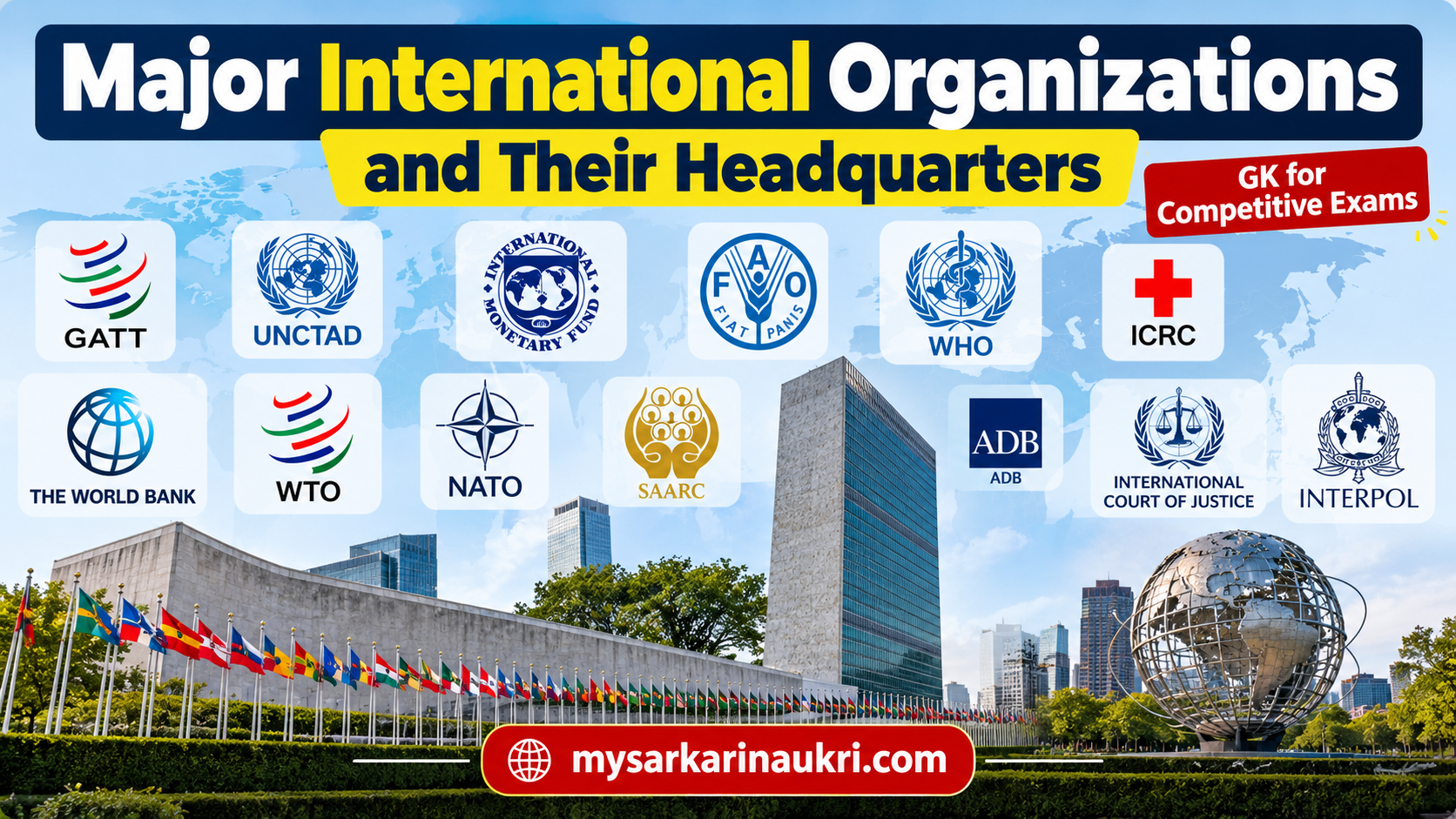
International organizations play an important role in global trade, economic development, public health, international security, law enforcement and cooperation among countries. Questions about their headquarters, establishment years, full forms and functions are frequently useful for General Knowledge (GK) preparation.
This topic is relevant for candidates preparing for SSC, Railway, Banking, UPSC, State PSC, Police, Defence, Teaching and other government recruitment examinations.
1. List of Major International Organizations and Their Headquarters
The following table covers the 15 organizations and groups in the supplied study material, with important factual clarifications for examination preparation.
|
No. |
Organization |
Headquarters |
Establishment year / key date |
|---|---|---|---|
|
1 |
General Agreement on Tariffs and Trade (GATT) |
Geneva, Switzerland |
1947 |
|
2 |
Group of Eight (G8) |
No separate permanent headquarters |
1975 — predecessor group established |
|
3 |
United Nations Conference on Trade and Development (UNCTAD) |
Geneva, Switzerland |
1964 |
|
4 |
International Monetary Fund (IMF) |
Washington, D.C., USA |
1944 — established at Bretton Woods |
|
5 |
Food and Agriculture Organization (FAO) |
Rome, Italy |
1945 |
|
6 |
World Health Organization (WHO) |
Geneva, Switzerland |
1948 |
|
7 |
International Committee of the Red Cross (ICRC) |
Geneva, Switzerland |
1863 |
|
8 |
World Bank |
Washington, D.C., USA |
1944 — agreement formulated at Bretton Woods |
|
9 |
Group of Fifteen (G-15) |
Geneva, Switzerland, commonly associated with its coordination arrangements |
1989 |
|
10 |
World Trade Organization (WTO) |
Geneva, Switzerland |
1995 |
|
11 |
North Atlantic Treaty Organization (NATO) |
Brussels, Belgium |
1949 |
|
12 |
South Asian Association for Regional Cooperation (SAARC) |
Kathmandu, Nepal |
1985 |
|
13 |
Asian Development Bank (ADB) |
Manila, Philippines |
1966 |
|
14 |
International Court of Justice (ICJ) |
The Hague, Netherlands |
Began work in 1946 |
|
15 |
International Criminal Police Organization (INTERPOL) |
Lyon, France |
1923 |
Important: Some years refer to the signing of an agreement, some to an organization's establishment, and others to the start of operations. These dates are not always identical. For example, the IMF was established in 1944, its Articles of Agreement entered into force in 1945, and it began operations in 1947.
2. Full Forms and Functions of Important Organizations
Knowing the full form and primary function of an organization helps students remember its headquarters and distinguish it from similar institutions.
|
Organization |
Full Form |
Main Function |
|---|---|---|
|
GATT |
General Agreement on Tariffs and Trade |
Establishes rules for international trade in goods and promotes tariff reduction. |
|
G8 |
Group of Eight |
Former grouping of major industrialized economies for economic and political discussions. |
|
UNCTAD |
United Nations Conference on Trade and Development |
Promotes trade and development, particularly in developing countries. |
|
IMF |
International Monetary Fund |
Promotes international monetary cooperation and financial stability. |
|
FAO |
Food and Agriculture Organization |
Works on food security, agriculture, nutrition and hunger reduction. |
|
WHO |
World Health Organization |
Coordinates international public health efforts. |
|
ICRC |
International Committee of the Red Cross |
Protects and assists people affected by armed conflict. |
|
World Bank |
World Bank |
Provides development financing and support to reduce poverty. |
|
G-15 |
Group of Fifteen |
Promotes cooperation among developing countries. |
|
WTO |
World Trade Organization |
Administers international trade agreements and provides a framework for trade negotiations. |
|
NATO |
North Atlantic Treaty Organization |
A political and military alliance based on collective defence. |
|
SAARC |
South Asian Association for Regional Cooperation |
Promotes regional cooperation among South Asian countries. |
|
ADB |
Asian Development Bank |
Supports economic and social development in Asia and the Pacific. |
|
ICJ |
International Court of Justice |
Settles legal disputes between states and provides advisory opinions. |
|
INTERPOL |
International Criminal Police Organization |
Facilitates international police cooperation against cross-border crime. |
3. Important Facts to Remember for Competitive Exams
A. Geneva, Switzerland


Geneva is a major centre of international diplomacy and cooperation. Several important organizations have their headquarters there:
-
GATT
-
UNCTAD
-
WHO
-
ICRC
-
WTO
Memory tip: Remember Geneva as a centre for international trade, health and humanitarian cooperation. GATT's 1947 agreement was signed in Geneva, and the WTO began operating in 1995.
B. Washington, D.C., USA


Two major international financial institutions are headquartered in Washington, D.C.:
-
International Monetary Fund (IMF)
-
World Bank
Memory tip: Associate Washington, D.C., with international monetary cooperation, financial assistance and development financing.
C. Other important headquarters
-
Rome, Italy: Food and Agriculture Organization (FAO).
-
Brussels, Belgium: NATO.
-
Kathmandu, Nepal: SAARC Secretariat.
-
Manila, Philippines: Asian Development Bank.
-
The Hague, Netherlands: International Court of Justice.
-
Lyon, France: INTERPOL.
These locations are particularly useful for direct one-mark GK questions.
4. Important Corrections and Commonly Confused Facts
Some facts in traditional GK lists require clarification. Remember these distinctions while preparing for objective examinations.
|
Topic |
Correct fact |
|---|---|
|
GATT and WTO |
GATT was signed in 1947 and entered into force in 1948. The WTO was established on 1 January 1995. GATT 1994 remains part of the WTO framework. |
|
G8 |
The first summit of the Group of Six took place in 1975. Canada joined in 1976, and Russia subsequently joined the grouping. Russia's participation was suspended in 2014, after which the format returned to G7. |
|
IMF |
The IMF was established in 1944, its Articles of Agreement entered into force in 1945, and it began operations in 1947. |
|
World Bank |
The World Bank's founding agreements were formulated at Bretton Woods in 1944. Its headquarters are in Washington, D.C. |
|
Red Cross |
The answer “Geneva, 1863” refers specifically to the International Committee of the Red Cross (ICRC), not every organization within the wider International Red Cross and Red Crescent Movement. |
|
International Court of Justice |
The ICJ is based at the Peace Palace in The Hague, Netherlands. It began work in 1946. |
|
INTERPOL |
INTERPOL was established in 1923 in Vienna, Austria. Its current headquarters are in Lyon, France, not Paris. |
|
G-15 |
G-15 is a group of developing countries, not a single country-based institution with a conventional headquarters in the same sense as the IMF or WTO. Verify any question specifically asking about its secretariat or coordination office against an authoritative source. |
Frequently Asked Questions
1. Which international organizations have their headquarters in Geneva?
Important examples include UNCTAD, WHO, WTO and ICRC. Geneva is also historically associated with GATT.
2. Which organizations are headquartered in Washington, D.C.?
The International Monetary Fund (IMF) and the World Bank are headquartered in Washington, D.C., USA.
3. What is the difference between GATT and WTO?
GATT is an agreement that governed much of international trade in goods from 1948. The WTO, established in 1995, is an international organization with a broader framework covering trade in goods, services and intellectual property.
4. Where is INTERPOL headquartered?
INTERPOL is headquartered in Lyon, France. It was established in Vienna, Austria, in 1923.
5. Where is the International Court of Justice located?
The International Court of Justice is located at the Peace Palace in The Hague, Netherlands. It is the principal judicial organ of the United Nations.
6. How should students prepare this topic for competitive exams?
Memorize organizations in groups based on their headquarters, practise full-form questions, revise establishment years separately, and solve MCQs regularly. Pay special attention to similar organizations and historical dates that are frequently confused.