15 Women Members of the Constituent Assembly of India
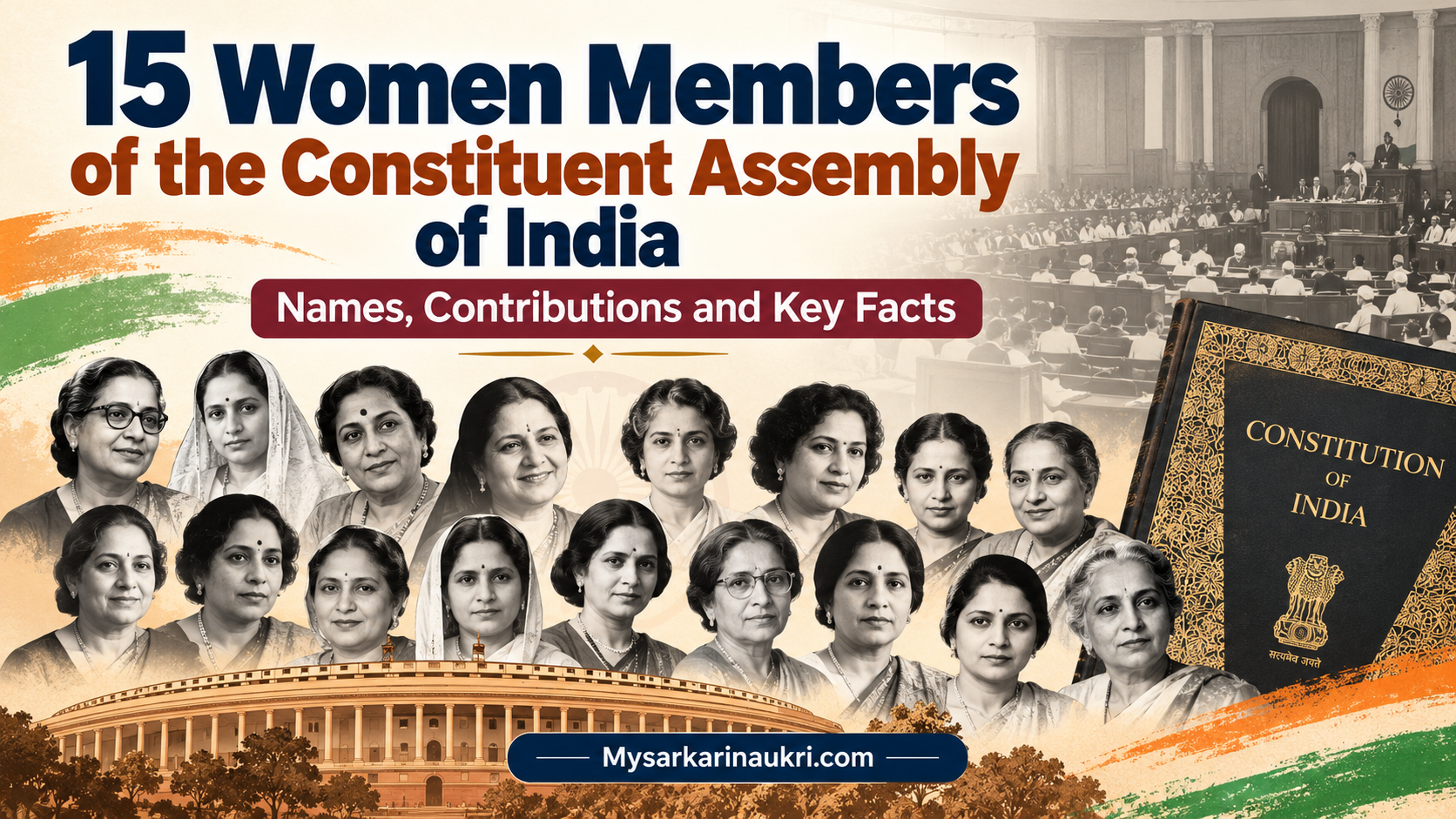
The Indian Constitution is the foundation of the country's democratic system. Its creation involved extensive debates on fundamental rights, equality, citizenship, social justice and the structure of government. Among the members who participated in this historic process were 15 women whose contributions helped shape India's constitutional and democratic journey.
These women came from different regions and social backgrounds. They included freedom fighters, educationists, lawyers, political leaders and social reformers. Their work brought important perspectives on women's rights, caste discrimination, education, public health and equal citizenship into national discussions.
This article explores the complete list of the 15 women members of the Constituent Assembly, their contributions, important historical facts and practice questions for government exam preparation.
1. List of the 15 Women Members of the Constituent Assembly
The following list is based on the publication of the Rajya Sabha Secretariat, Selected Speeches of Women Members of the Constituent Assembly.
| No. | Name | Major Area of Contribution |
|---|---|---|
| 1 | Ammu Swaminathan | Women's rights and social reform |
| 2 | Annie Mascarene | Freedom movement and constitutional debates |
| 3 | Begum Aizaz Rasul | Democratic politics and secularism |
| 4 | Dakshayani Velayudhan | Social equality and anti-caste reform |
| 5 | Durgabai Deshmukh | Education, social welfare and women's empowerment |
| 6 | Hansa Mehta | Gender equality and human rights |
| 7 | Kamla Chaudhri | Nationalist activities and social reform |
| 8 | Leela Roy | Women's education and the freedom movement |
| 9 | Malati Choudhury | Rural development and social justice |
| 10 | Purnima Banerjee | Nationalist politics and public service |
| 11 | Rajkumari Amrit Kaur | Public health and medical education |
| 12 | Renuka Ray | Women's rights and legal reform |
| 13 | Sarojini Naidu | Freedom movement and women's political participation |
| 14 | Sucheta Kripalani | Independence movement and political leadership |
| 15 | Vijaya Lakshmi Pandit | Diplomacy and international relations |
The Constituent Assembly was originally established in 1946. Its membership changed following Partition in 1947. The Assembly ultimately adopted the Constitution on 26 November 1949, and it came into effect on 26 January 1950.
2. Contributions of the 15 Women Members
1. Ammu Swaminathan
Ammu Swaminathan was a freedom fighter, social reformer and advocate of women's rights. She was associated with the Women's India Association, which worked to improve women's social, educational and political position.
Her participation in the Constituent Assembly reflected the importance of equal citizenship and women's participation in public life.
Key facts:
-
Worked for women's rights and social reform.
-
Supported women's participation in political and public institutions.
-
Associated with the Women's India Association.
2. Annie Mascarene
Annie Mascarene was a freedom fighter and political leader from Travancore, now part of Kerala. She participated in the movement for responsible government and played a role in the political developments surrounding the integration of princely states.
She also participated in constitutional discussions, including matters relating to the structure and administration of the Indian Union.
Key facts:
-
Associated with the political movement in Travancore.
-
Participated in the freedom struggle.
-
Contributed to the work of the Constituent Assembly.
3. Begum Aizaz Rasul
Begum Aizaz Rasul was the only Muslim woman member of the Constituent Assembly. She was a prominent political figure who participated in debates concerning India's political and constitutional future.
She is also remembered for her public life after independence, including her involvement in parliamentary politics and sports administration.
Key facts:
-
The only Muslim woman member of the Constituent Assembly.
-
Participated in constitutional and political discussions.
-
Contributed to public life after independence.
4. Dakshayani Velayudhan
Dakshayani Velayudhan was a pioneering social reformer from Kerala and the only Dalit woman member of the Constituent Assembly. She came from a community historically subjected to caste discrimination and challenged social practices that denied people dignity and equality.
She opposed untouchability and supported the creation of a democratic society based on equal rights. Her participation was particularly significant in discussions about social justice and the position of disadvantaged communities.
Key facts:
-
The only Dalit woman member of the Constituent Assembly.
-
Advocated equality and human dignity.
-
Opposed untouchability and caste-based discrimination.
5. Durgabai Deshmukh
Durgabai Deshmukh was a freedom fighter, lawyer and social worker. She devoted much of her life to women's education, social welfare and the rehabilitation of disadvantaged people.
She later played an important role in social development initiatives in independent India. Her work helped strengthen institutions concerned with education, welfare and women's advancement.
Key facts:
-
Worked for women's education and social welfare.
-
Participated in the freedom movement.
-
Contributed to social development after independence.
6. Hansa Mehta
Hansa Mehta was an educationist, writer, social reformer and advocate of gender equality. She contributed to constitutional discussions concerning fundamental rights and the equal status of women.
Her international work was also significant. As a member of the United Nations Commission on Human Rights, she contributed to efforts to ensure that the Universal Declaration of Human Rights used language inclusive of both women and men.
Key facts:
-
Advocated equal rights and opportunities for women.
-
Participated in discussions on fundamental rights.
-
Contributed to international human rights work.
7. Kamla Chaudhri
Kamla Chaudhri was a writer, freedom fighter and social worker. She participated in the nationalist movement and supported greater involvement of women in public affairs.
Her contribution represents the connection between the independence struggle and efforts to bring about wider social and political change.
Key facts:
-
Associated with the freedom movement.
-
Worked in social and political life.
-
Supported women's participation in public affairs.
8. Leela Roy
Leela Roy, also known as Leela Nag, was an educationist, revolutionary and women's rights activist associated with Bengal. She worked to expand educational opportunities for women and encouraged their participation in nationalist activities.
Through her work with women's organisations, she contributed to political awareness and social reform.
Key facts:
-
Associated with Bengal's nationalist movement.
-
Promoted women's education.
-
Worked for women's political and social participation.
9. Malati Choudhury
Malati Choudhury was a freedom fighter and social worker associated with Odisha. She worked on rural development, education and the welfare of disadvantaged communities.
Her public activities reflected the importance of grassroots participation and social justice in the broader process of nation-building.
Key facts:
-
Participated in the freedom movement.
-
Worked for rural development and social welfare.
-
Associated with social reform in Odisha.
10. Purnima Banerjee
Purnima Banerjee was a freedom fighter and political activist who participated in nationalist activities. She contributed to the work of the Constituent Assembly during a period when India was defining its future political and constitutional institutions.
Her life illustrates the role of political organisers and freedom fighters in the transition from colonial rule to democratic governance.
Key facts:
-
Participated in the nationalist movement.
-
Contributed to the work of the Constituent Assembly.
-
Associated with public and political activities.
11. Rajkumari Amrit Kaur
Rajkumari Amrit Kaur was a freedom fighter, social reformer and advocate of public health. After independence, she became India's first Union Minister of Health.
She worked to improve healthcare services and medical education. She also played an important role in efforts leading to the establishment of the All India Institute of Medical Sciences (AIIMS) in New Delhi.
Key facts:
-
India's first Union Health Minister.
-
Promoted public health and medical education.
-
Associated with the establishment of AIIMS.
12. Renuka Ray
Renuka Ray was a freedom fighter, social worker and advocate of women's rights. She worked on questions relating to women's legal status, property rights and social equality.
Her public life was closely connected with efforts to reform laws and institutions that restricted women's opportunities.
Key facts:
-
Advocated women's legal and property rights.
-
Worked for social reform.
-
Participated in public and political life.
13. Sarojini Naidu
Sarojini Naidu was a celebrated poet, freedom fighter and political leader. Popularly known as the Nightingale of India, she played an important role in the Indian National Movement and encouraged women's participation in the struggle for independence.
After independence, she became the Governor of the United Provinces, now Uttar Pradesh, and is widely recognised as India's first woman Governor.
Key facts:
-
Known as the Nightingale of India.
-
Participated in the national freedom movement.
-
Became India's first woman Governor.
14. Sucheta Kripalani
Sucheta Kripalani was a freedom fighter and political leader who participated in the Quit India Movement of 1942. She worked in the nationalist movement and contributed to the Constituent Assembly.
In 1963, she became the Chief Minister of Uttar Pradesh, making her the first woman Chief Minister of an Indian state.
Key facts:
-
Participated in the Quit India Movement.
-
Contributed to the Constituent Assembly.
-
India's first woman Chief Minister.
15. Vijaya Lakshmi Pandit
Vijaya Lakshmi Pandit was a freedom fighter, diplomat and political leader. After independence, she represented India in international forums and helped establish India's diplomatic presence.
In 1953, she became the first woman President of the United Nations General Assembly, an important milestone in international diplomacy.
Key facts:
-
Participated in India's freedom movement.
-
Served as a diplomat.
-
Became the first woman President of the UN General Assembly.
3. How Did Women Contribute to the Making of the Indian Constitution?
The contributions of women in the Constituent Assembly extended beyond representation. They brought a range of social and political experiences into discussions about India's future.
Gender equality
Women members advocated equal citizenship and legal protection. Their participation helped reinforce the principle that women should enjoy the same fundamental rights as men.
Social justice
Dakshayani Velayudhan and other members brought attention to caste discrimination, untouchability and the need to protect human dignity.
Fundamental rights
Members such as Hansa Mehta participated in debates concerning rights, equality and the constitutional status of citizens.
Education and social welfare
Several women members had worked in education, public health and social reform before independence. Their experience helped bring these issues into the wider national conversation.
Democratic participation
Their presence demonstrated that constitution-making was not solely a discussion among male political leaders. Women participated in debates and helped shape the democratic framework of the new Republic.
The Government of India's Ministry of Law and Justice published a dedicated volume on the lives and contributions of these 15 women in March 2025. <Link url="https://www.pib.gov.in/PressReleasePage.aspx?PRID=2109365&lang=2®=48" title="Read the government announcement"/>.
4. Important Facts to Remember
| Historical Question | Answer |
|---|---|
| How many women were members of the Constituent Assembly? | 15 |
| Who was the only Dalit woman member? | Dakshayani Velayudhan |
| Who was the only Muslim woman member? | Begum Aizaz Rasul |
| Who was associated with gender equality and international human rights work? | Hansa Mehta |
| Who was India's first Union Health Minister? | Rajkumari Amrit Kaur |
| Who was known as the Nightingale of India? | Sarojini Naidu |
| Who became India's first woman Chief Minister? | Sucheta Kripalani |
| Who was the first woman President of the UN General Assembly? | Vijaya Lakshmi Pandit |
| When was the Constitution adopted? | 26 November 1949 |
| When did the Constitution come into effect? | 26 January 1950 |
5. Practice Questions for Competitive Examinations
Test your understanding with these multiple-choice questions.
Question 1
How many women were members of the Constituent Assembly of India?
A. 10
B. 12
C. 15
D. 20
Correct Answer: C. 15
Explanation: The Constituent Assembly included 15 women members who participated in the constitution-making process.
Question 2
Who was the only Dalit woman member of the Constituent Assembly?
A. Hansa Mehta
B. Dakshayani Velayudhan
C. Durgabai Deshmukh
D. Sarojini Naidu
Correct Answer: B. Dakshayani Velayudhan
Explanation: Dakshayani Velayudhan advocated social equality and opposed caste-based discrimination.
Question 3
Who was the only Muslim woman member of the Constituent Assembly?
A. Renuka Ray
B. Annie Mascarene
C. Begum Aizaz Rasul
D. Kamla Chaudhri
Correct Answer: C. Begum Aizaz Rasul
Explanation: Begum Aizaz Rasul was the only Muslim woman member of the Constituent Assembly.
Question 4
Which woman member is particularly associated with gender equality and international human rights work?
A. Hansa Mehta
B. Malati Choudhury
C. Leela Roy
D. Purnima Banerjee
Correct Answer: A. Hansa Mehta
Explanation: Hansa Mehta advocated gender equality and contributed to international human rights efforts.
Question 5
Who was India's first Union Minister of Health?
A. Vijaya Lakshmi Pandit
B. Sucheta Kripalani
C. Rajkumari Amrit Kaur
D. Sarojini Naidu
Correct Answer: C. Rajkumari Amrit Kaur
Explanation: Rajkumari Amrit Kaur held the Health portfolio in independent India's first government.
Question 6
Who was popularly known as the Nightingale of India?
A. Hansa Mehta
B. Sarojini Naidu
C. Dakshayani Velayudhan
D. Renuka Ray
Correct Answer: B. Sarojini Naidu
Explanation: Sarojini Naidu was a prominent poet and leader of the Indian freedom movement.
Question 7
Who became India's first woman Chief Minister?
A. Rajkumari Amrit Kaur
B. Sucheta Kripalani
C. Vijaya Lakshmi Pandit
D. Durgabai Deshmukh
Correct Answer: B. Sucheta Kripalani
Explanation: Sucheta Kripalani became Chief Minister of Uttar Pradesh in 1963.
Question 8
Who became the first woman President of the United Nations General Assembly?
A. Sarojini Naidu
B. Hansa Mehta
C. Vijaya Lakshmi Pandit
D. Begum Aizaz Rasul
Correct Answer: C. Vijaya Lakshmi Pandit
Explanation: Vijaya Lakshmi Pandit held the presidency of the UN General Assembly in 1953.
6. Frequently Asked Questions
How many women were members of the Constituent Assembly of India?
There were 15 women members of the Constituent Assembly.
Who was the only Dalit woman in the Constituent Assembly?
Dakshayani Velayudhan was the only Dalit woman member of the Assembly.
Who was the only Muslim woman member?
Begum Aizaz Rasul was the only Muslim woman member of the Constituent Assembly.
What was Hansa Mehta's contribution?
Hansa Mehta advocated gender equality and participated in discussions on fundamental rights. She also contributed to international human rights work.
Why are the women members of the Constituent Assembly important?
They brought perspectives on equality, social justice, education, public health and women's rights into India's constitutional and democratic development.
Where can readers find reliable historical information?
Readers can consult publications of the Ministry of Law and Justice, the Rajya Sabha Secretariat and the Lok Sabha Secretariat.
7. Official Sources and Further Reading
-
Ministry of Law and Justice, Government of India: The Life and Contributions of the Women Members of the Constituent Assembly. Read the official announcement.
-
Rajya Sabha Secretariat: Selected Speeches of Women Members of the Constituent Assembly.
Read the parliamentary publication. -
Lok Sabha Secretariat: Parliamentary records documenting the participation of women in the Constituent Assembly.
Explore the parliamentary digital library.
Conclusion
The 15 women members of the Constituent Assembly made valuable contributions to India's constitutional history. Their experiences in the freedom movement, education, social reform, public health and diplomacy helped bring a wider range of perspectives into the development of India's democratic institutions.
Learning about these women provides a deeper understanding of how the Constitution emerged from collective debate and participation. Their contributions remain an important part of India's history and the continuing pursuit of equality, justice and democratic citizenship.